

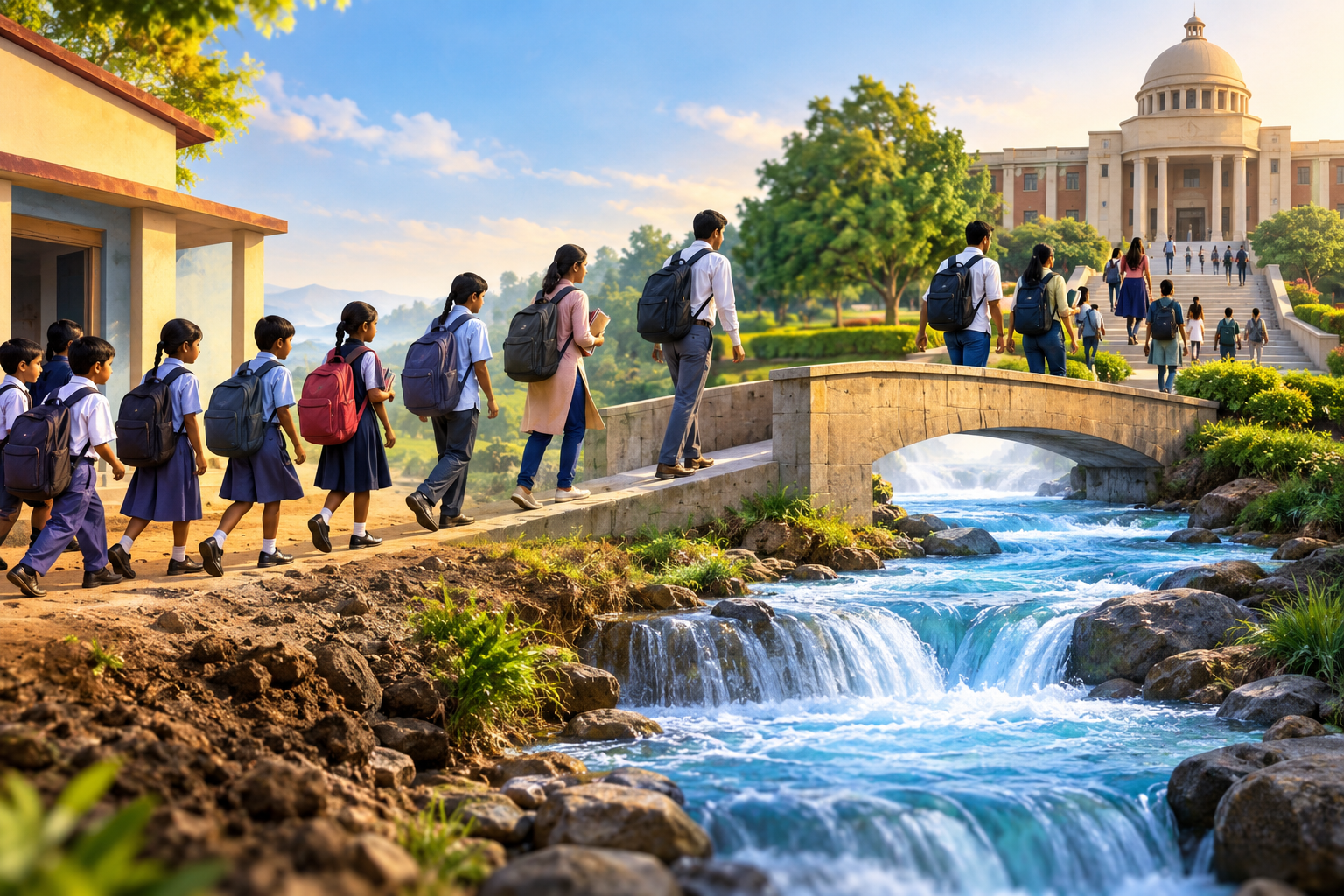
Why School Support Matters Before College Begins
Most debates about Indian higher education focus on universities themselves — funding, faculty, rankings. But the data suggest the problem starts much earlier: in a Class 9 classroom in Muzaffarpur, or a Class 11 classroom in Ranchi.
There is a quiet assumption behind most discussions of Indian higher education — that better universities can be built mainly through universities themselves, meaning more funding, more teachers, more research, better rankings. The data suggest the problem begins much earlier than that. The strength of higher education depends partly on the strength of the school system feeding students into it, and if large numbers of students leave school before Class 12, universities are left with a smaller pool of students prepared to enter higher education at all.
01The Leak Before College
Chart 1 — From Class 1 to Class 12
Source: UDISE+ 2025-26 school pipeline data, as cited in the Higher Education Report Card series (Prof. Arun C. Mehta, Education for All in India, August 2026).
Only 51.9 per cent — just under 52 out of every 100 children who enter Class 1 — reach Class 12 — meaning almost half the children who enter the school system never reach its end. For higher education, this represents a major loss of potential students before they even become eligible to enter college, which is exactly why school retention deserves to be treated as one of the most important indicators shaping the future supply of students into Indian higher education.
02The Quality Problem Hidden Inside the Quantity Problem
It is easy to see India’s higher-education challenge mainly as a numbers problem. The Gross Enrolment Ratio (GER) stands at about 30 per cent today, against a target of 50 per cent by 2035, so the obvious response is to raise enrolment. But higher enrolment on its own does not guarantee better higher education — the quality of the students entering the system matters just as much.
Chart 2 — Pupil-Teacher Ratio, National vs Bihar
Source: AISHE 2023-24 (regular and distance mode combined), as cited in the Higher Education Report Card series.
The connection becomes clearer once we look inside institutions. When more students enter higher education without a matching increase in well-prepared students and teachers, institutions come under greater strain. The national pupil-teacher ratio (regular and distance combined) already stands at 25:1; in Bihar it reaches 61:1 — a gap large enough that teachers in some states are serving well over double the students that teachers in better-staffed systems handle. The same pressure shapes academic work directly: when students arrive without a strong foundation, teachers may have to spend more time on basic material instead of advanced coursework, and when the pool of well-prepared applicants is thin, institutions have far less room to be selective in admissions. None of this is a failure of colleges and universities. It is, in good part, the result of asking higher education to compensate for gaps that opened up much earlier in the system.
03What a Healthier Pipeline Can Provide
A university can only be as strong as the students who enter it. A student who completes twelve full years of schooling has had more time to build the knowledge base higher education requires, and is less likely to have been lost to the system through economic hardship or during the always-difficult transition from secondary to higher secondary school. Reaching Class 12, in other words, raises the odds that a student enters college with a stronger foundation and a better chance of finishing the degree.
Chart 3 — Pupil-Teacher Ratio, Regular Mode, Selected States
| State | PTR, regular mode |
|---|---|
| Kerala, Tamil Nadu, Karnataka | 14:1 to 16:1 |
| Bihar | 57:1 |
Source: AISHE 2023-24, regular-mode PTR, as reported in the Higher Education Report Card series.
State-level data confirm part of this picture, though not all of it. Tamil Nadu, Delhi, Chandigarh, and Puducherry have already crossed the NEP 2020 target of 50 per cent GER, and each of these states also runs a pupil-teacher ratio well below the national figure. What the underlying report card does not provide is state-specific school retention data — only national figures are available there — so it would go beyond the evidence to claim these particular states also hold on to more of their own students through Class 12; that remains a plausible hypothesis, not a demonstrated fact. What the data do show clearly is that better-staffed higher-education systems and higher GER tend to travel together: Kerala, Tamil Nadu, and Karnataka post the country’s best pupil-teacher ratios, between 14:1 and 16:1 in regular mode, against Bihar’s 57:1 — figures that matter because how many students reach higher education, and how well institutions are equipped to teach them, are two connected parts of the same pipeline.
04The Opposite Pattern
Bihar’s Gap to Target
The opposite pattern shows up in states with large higher-education gaps. Bihar’s GER stands at only 17.7 per cent, 12.3 percentage points below the national average, and to reach 50 per cent by 2034–35 it would need to raise enrolment by 9.9 per cent every year — more than twice the roughly 4.75 per cent a year needed nationally to hit the same target. An increase of that size cannot be achieved simply by adding college seats, because more seats matter only if enough students remain in school long enough to become potential entrants in the first place. This is why school retention has to be treated as a necessary part of the solution: a college-building programme can add capacity, but it cannot replace students who have already left the education system. Keeping students in school through Classes 9 and 10, and helping them reach Class 12, is what actually expands the pool higher education can draw from.
05The Good News Nobody Is Talking About
The same data also contain an encouraging finding that deserves more attention than it gets. In a single year, national retention from Class 1 to Class 12 rose from 47.2 per cent to 51.9 per cent — a jump of 4.7 percentage points, the largest one-year improvement recorded across the school education pipeline’s indicators. In fact, all five indicators UDISE+ tracks moved the same way over the same year: the dropout rate fell 2.0 percentage points (11.5 to 9.5 per cent), the transition rate from secondary to higher secondary school rose 3.0 percentage points (75.1 to 78.1 per cent), Higher Secondary GER rose 3.3 percentage points (58.4 to 61.7 per cent), and Secondary GER itself rose 2.8 percentage points (78.7 to 81.5 per cent).
Chart 4 — One-Year Change Across Pipeline Indicators
Source: UDISE+ 2025-26, national school pipeline indicators, 2024-25 to 2025-26.
Taken together, these changes show that the school pipeline can genuinely improve within a relatively short period, and that retention should not be treated as a fixed demographic fact that only shifts across generations — school participation can respond to changes in attention, support, and resources within a single academic year. The open question is whether this improvement can be sustained. If retention stays higher over several years, more students will eventually reach higher education, though the effect will show up with a lag, since today’s school students are tomorrow’s college applicants. On the higher-education side itself, enrolment has been growing at about 3.95 per cent a year over the past five years, against the 4.75 per cent a year needed to reach 50 per cent GER by 2034–35 — a gap that has narrowed but not closed, and one that puts India on course for a GER of roughly 46 per cent at the current pace, short of the target. The likely gain from stronger school retention is not simply a larger number of students in higher education, but a larger share who have completed the full school cycle and arrive better prepared for college-level work.
06Rethinking Where Investment Should Go
Where the Money Is Going
Public spending on higher education currently runs at about 0.7–0.8 per cent of GDP, well short of what the sector’s broader goals would require, and the 2026–27 budget raised the higher-education allocation by 11.3 per cent — a meaningful increase that will help build capacity. But the evidence on school retention suggests capacity is only one part of the problem. If the aim is not simply more graduates but genuinely better institutions, investment has to look beyond university campuses: India needs universities that can compete on research quality, institutions that can afford to be selective because enough well-prepared students are available, and enough teachers to sustain ratios that allow real teaching rather than crowd management.
This reframes the question of where the next rupee should go. In a state that has already reached its GER target, another university building may add genuinely useful capacity. In a state where many students are still leaving school before Class 12, however, keeping those students in school may address a more basic constraint further up the same pipeline. Consider a Class 10 student in Bihar or Jharkhand: if that student leaves school, higher education loses a potential entrant several years down the line; if the student stays and reaches Class 12, the system gains not just a potential entrant but one with two additional years to build the academic foundation college requires. Repeated across an entire cohort, that difference compounds — a higher share of students reaching Class 12 expands the pool of potential entrants, and if those students also arrive better prepared, universities can spend less of their limited teaching capacity closing basic gaps and more of it on advanced coursework and research.
“Fixing the leak at the source does more than fill the reservoir downstream. It can improve the quality of what reaches it.”
07The Real Renovation
Indian higher education does not suffer from a shortage of ambition. New universities are being built, budgets are rising, enrolment is climbing — but the evidence shows that expansion at the university level cannot be separated from what happens earlier in the school system. What India needs is a more stable and complete flow of students reaching higher education with the preparation they actually need: students who were not lost somewhere across the eleven years before they ever had the chance to consider college.
If India can reduce the loss of students before Class 12, the effect will eventually move downstream into colleges and universities — not simply as more students, but as a larger pool who completed school and arrive genuinely ready to learn.
The Basic Problem, in Two Numbers
Only about half of the children who begin Class 1 currently reach Class 12, and national higher-education enrolment is growing more slowly than the pace needed to hit the 2035 target. The recent one-year rise in national retention shows that this part of the system can, in fact, improve — the real test is whether that improvement holds, and whether it reaches the states currently furthest behind.
Fixing the leak at the source does more than fill the reservoir downstream. It improves what actually reaches it.
Figures cited — school retention, pupil-teacher ratios, GER, and higher-education budget allocations — are drawn from AISHE 2023-24, UDISE+ 2025-26 (released 7 July 2026), and Union Budget 2026-27, as compiled in “Higher Education in India: Where Do We Stand?” (Prof. Arun C. Mehta, Education for All in India, August 2026). School pipeline indicators cited here are national figures; the underlying report card does not publish state-specific retention or dropout data.
कॉलेज से पहले हो रहे रिसाव को ठीक करना
भारत की उच्च शिक्षा को लेकर ज़्यादातर बहस यूनिवर्सिटी पर ही टिकी रहती है — फ़ंडिंग, टीचर, रैंकिंग। मगर आँकड़े बताते हैं कि असली समस्या कहीं पहले शुरू होती है — मुज़फ़्फ़रपुर की किसी नौवीं क्लास में, या रांची की किसी ग्यारहवीं क्लास में।
भारत की उच्च शिक्षा को लेकर ज़्यादातर बातचीत के पीछे एक चुपचाप मान ली गई बात होती है — कि बेहतर यूनिवर्सिटी सिर्फ़ यूनिवर्सिटी के अंदर से ही बनाई जा सकती हैं, यानी ज़्यादा फ़ंडिंग, ज़्यादा टीचर, ज़्यादा रिसर्च, बेहतर रैंकिंग। मगर आँकड़े बताते हैं कि असली समस्या इससे कहीं पहले शुरू हो जाती है। उच्च शिक्षा की मज़बूती इस बात पर भी टिकी है कि उसे पढ़ाई देने वाला स्कूल सिस्टम कितना मज़बूत है — अगर बड़ी तादाद में बच्चे बारहवीं क्लास तक पहुँचने से पहले ही स्कूल छोड़ देते हैं, तो यूनिवर्सिटी के पास तैयार छात्रों की गिनती वैसे भी घट जाती है।
01कॉलेज से पहले का रिसाव
चार्ट 1 — पहली से बारहवीं क्लास तक
स्रोत: UDISE+ 2025-26 स्कूल शिक्षा पाइपलाइन आँकड़े, जैसा कि हायर एजुकेशन रिपोर्ट कार्ड सीरीज़ (प्रो. अरुण सी. मेहता, Education for All in India, अगस्त 2026) में दर्ज है।
पहली क्लास में दाख़िल होने वाले हर 100 बच्चों में से सिर्फ़ 51.9 फ़ीसदी यानी लगभग 52 बच्चे ही बारहवीं तक पहुँच पाते हैं — यानी स्कूल सिस्टम में दाख़िल होने वाले लगभग आधे बच्चे कभी उसके आख़िर तक नहीं पहुँचते। उच्च शिक्षा के लिए इसका मतलब है कि कॉलेज में दाख़िले लायक़ बनने से पहले ही बहुत सारे संभावित छात्र खो जाते हैं — और यही वजह है कि स्कूल में बच्चों का टिके रहना, भारत की उच्च शिक्षा में आगे कितने छात्र आएँगे, इसका एक सबसे ज़रूरी संकेतक माना जाना चाहिए।
02गिनती की समस्या के अंदर छुपी क्वालिटी की समस्या
भारत की उच्च शिक्षा की चुनौती को सिर्फ़ आँकड़ों की समस्या मान लेना आसान है। ग्रॉस एनरोलमेंट रेशियो (GER) आज लगभग 30 फ़ीसदी है, जबकि 2035 तक इसे 50 फ़ीसदी तक पहुँचाने का लक्ष्य है, तो साफ़ जवाब लगता है — दाख़िले बढ़ाओ। मगर सिर्फ़ ज़्यादा दाख़िले होने से बेहतर उच्च शिक्षा की गारंटी नहीं मिलती — सिस्टम में आने वाले छात्रों की तैयारी भी उतनी ही मायने रखती है।
चार्ट 2 — छात्र-शिक्षक अनुपात, राष्ट्रीय बनाम बिहार
स्रोत: AISHE 2023-24 (रेगुलर और डिस्टेंस मोड मिलाकर), जैसा हायर एजुकेशन रिपोर्ट कार्ड सीरीज़ में दर्ज है।
ये कड़ी तभी साफ़ दिखती है जब हम संस्थानों के अंदर झाँकते हैं। जब उच्च शिक्षा में ज़्यादा छात्र आते हैं, मगर उतनी ही रफ़्तार से तैयार छात्र और टीचर नहीं बढ़ते, तो संस्थानों पर दबाव बढ़ जाता है। राष्ट्रीय छात्र-शिक्षक अनुपात (रेगुलर और डिस्टेंस मोड मिलाकर) पहले से 25:1 है; बिहार में ये 61:1 तक पहुँच जाता है — इतना बड़ा फ़र्क़ कि कुछ राज्यों के टीचर, बेहतर स्टाफ़ वाले सिस्टम के मुक़ाबले दोगुने से भी ज़्यादा छात्रों को संभाल रहे हैं। यही दबाव पढ़ाई के असली काम पर भी असर डालता है — जब छात्र बिना मज़बूत बुनियाद के आते हैं, तो टीचर को एडवांस पढ़ाई की बजाय बुनियादी चीज़ें दोबारा पढ़ाने में ज़्यादा वक़्त देना पड़ता है, और जब तैयार आवेदकों की गिनती कम हो, तो संस्थानों के पास दाख़िले में चुनिंदा रहने की गुंजाइश भी कम बचती है। इसमें कॉलेज और यूनिवर्सिटी की कोई ग़लती नहीं है। ये काफ़ी हद तक इस बात का नतीजा है कि उच्च शिक्षा से वो कमियाँ पूरी करने की उम्मीद की जा रही है जो सिस्टम में कहीं बहुत पहले पैदा हुई थीं।
03एक बेहतर पाइपलाइन क्या दे सकती है
कोई यूनिवर्सिटी उतनी ही मज़बूत हो सकती है जितने मज़बूत उसमें आने वाले छात्र हों। जो छात्र पूरे बारह साल की पढ़ाई पूरी करता है, उसे उच्च शिक्षा के लिए ज़रूरी बुनियाद बनाने का ज़्यादा वक़्त मिल जाता है, और आर्थिक तंगी या माध्यमिक से उच्च-माध्यमिक की हमेशा मुश्किल रहने वाली छलांग के दौरान सिस्टम से छूटने का ख़तरा भी कम हो जाता है। यानी बारहवीं तक पहुँचना, कॉलेज में एक मज़बूत बुनियाद के साथ दाख़िल होने और डिग्री पूरी करने के मौक़े दोनों को बढ़ा देता है।
चार्ट 3 — छात्र-शिक्षक अनुपात (रेगुलर मोड), कुछ राज्यों में
| राज्य | PTR, रेगुलर मोड |
|---|---|
| केरल, तमिलनाडु, कर्नाटक | 14:1 से 16:1 |
| बिहार | 57:1 |
स्रोत: AISHE 2023-24, रेगुलर मोड PTR, हायर एजुकेशन रिपोर्ट कार्ड सीरीज़ में दर्ज।
राज्य-स्तर के आँकड़े इस तस्वीर के एक हिस्से की पुष्टि करते हैं, पूरे की नहीं। तमिलनाडु, दिल्ली, चंडीगढ़, और पुदुच्चेरी ने NEP 2020 का 50 फ़ीसदी GER का लक्ष्य पहले ही पार कर लिया है, और इन्हीं राज्यों का छात्र-शिक्षक अनुपात भी राष्ट्रीय आँकड़े से काफ़ी बेहतर है। मगर जिस रिपोर्ट कार्ड से ये आँकड़े लिए गए हैं, उसमें राज्य-स्तर पर स्कूल रिटेंशन का कोई आँकड़ा शामिल नहीं है — सिर्फ़ राष्ट्रीय आँकड़े ही उपलब्ध हैं। इसलिए ये कहना कि इन राज्यों में बच्चे बारहवीं तक भी ज़्यादा टिके रहते हैं, आँकड़ों से आगे जाने वाली बात होगी — ये एक मुमकिन अंदाज़ा है, साबित हुई बात नहीं। जो बात आँकड़े साफ़ दिखाते हैं वो ये है कि बेहतर स्टाफ़ वाला उच्च शिक्षा सिस्टम और ज़्यादा GER अक्सर साथ-साथ चलते हैं — केरल, तमिलनाडु, और कर्नाटक का छात्र-शिक्षक अनुपात देश में सबसे अच्छा है, रेगुलर मोड में 14:1 से 16:1 के बीच, जबकि बिहार का 57:1 है — ये आँकड़े इसलिए मायने रखते हैं क्योंकि कितने छात्र उच्च शिक्षा तक पहुँचते हैं, और संस्थानों के पास उन्हें पढ़ाने की कितनी क्षमता है, ये एक ही पाइपलाइन के दो जुड़े हुए हिस्से हैं।
04इसका उल्टा नज़ारा
बिहार और लक्ष्य के बीच का फ़ासला
इसका उल्टा नज़ारा उन राज्यों में दिखता है जहाँ उच्च शिक्षा में बड़ा फ़ासला बना हुआ है। बिहार का GER सिर्फ़ 17.7 फ़ीसदी है, जो राष्ट्रीय औसत से 12.3 फ़ीसदी पॉइंट कम है, और 2034–35 तक 50 फ़ीसदी तक पहुँचने के लिए उसे हर साल 9.9 फ़ीसदी दाख़िले बढ़ाने होंगे — जो राष्ट्रीय स्तर पर ज़रूरी लगभग 4.75 फ़ीसदी सालाना बढ़त से दोगुने से भी ज़्यादा है। इतनी बड़ी बढ़त सिर्फ़ कॉलेज की सीटें बढ़ाकर हासिल नहीं की जा सकती, क्योंकि ज़्यादा सीटें तभी काम आती हैं जब इतने छात्र स्कूल में टिके रहें कि वो आगे चलकर दाख़िले के लायक़ बन सकें। यही वजह है कि स्कूल रिटेंशन को इस हल का एक ज़रूरी हिस्सा मानना पड़ेगा — कॉलेज बनाने का प्रोग्राम क्षमता तो बढ़ा सकता है, मगर उन छात्रों की जगह नहीं ले सकता जो पहले ही सिस्टम छोड़ चुके हैं। नौवीं और दसवीं क्लास के दौरान बच्चों को स्कूल में टिकाए रखना, और उन्हें बारहवीं तक पहुँचाना — यही असल में उस दायरे को बड़ा करता है जिससे उच्च शिक्षा अपने छात्र चुन सकती है।
05वो अच्छी ख़बर जिस पर कोई बात नहीं कर रहा
इन्हीं आँकड़ों में एक उम्मीद जगाने वाली बात भी छुपी है, जिसे जितना ध्यान मिलना चाहिए था, उतना नहीं मिल रहा। सिर्फ़ एक साल में, पहली से बारहवीं क्लास तक का राष्ट्रीय रिटेंशन 47.2 फ़ीसदी से बढ़कर 51.9 फ़ीसदी हो गया — यानी 4.7 फ़ीसदी पॉइंट की छलांग, जो स्कूल शिक्षा पाइपलाइन के तमाम संकेतकों में दर्ज सबसे बड़ा एक-साल का सुधार है। दरअसल UDISE+ जिन पाँच संकेतकों को ट्रैक करता है, वो सभी उसी साल बेहतर हुए — ड्रॉपआउट रेट 2.0 फ़ीसदी पॉइंट कम हुआ (11.5 से 9.5 फ़ीसदी), माध्यमिक से उच्च-माध्यमिक स्कूल तक जाने की दर 3.0 फ़ीसदी पॉइंट बढ़ी (75.1 से 78.1 फ़ीसदी), उच्च-माध्यमिक GER 3.3 फ़ीसदी पॉइंट बढ़ा (58.4 से 61.7 फ़ीसदी), और माध्यमिक GER भी ख़ुद 2.8 फ़ीसदी पॉइंट बढ़ा (78.7 से 81.5 फ़ीसदी)।
चार्ट 4 — एक साल में पाइपलाइन के संकेतकों में बदलाव
चर्चा में बताए गए हालिया रिपोर्टिंग साल का एक-साल का बदलाव।
इन सब बदलावों को साथ रखकर देखें, तो साफ़ पता चलता है कि स्कूल पाइपलाइन थोड़े ही समय में असल में बेहतर हो सकती है, और रिटेंशन को कोई तय-शुदा जनसांख्यिकीय हक़ीक़त मानकर नहीं बैठना चाहिए जो सिर्फ़ पीढ़ियों में बदलती है — स्कूल में बने रहने की दर, ध्यान, मदद, और संसाधनों में बदलाव के साथ एक ही शैक्षणिक साल में बदल सकती है। असली सवाल ये है कि क्या ये सुधार आगे भी बना रहेगा। अगर रिटेंशन कई सालों तक ऊँचा बना रहता है, तो आगे चलकर ज़्यादा छात्र उच्च शिक्षा तक पहुँचेंगे, हालाँकि इसका असर कुछ देर से दिखेगा, क्योंकि आज के स्कूली छात्र ही कल के कॉलेज के दावेदार हैं। इसका फ़ायदा सिर्फ़ उच्च शिक्षा में ज़्यादा छात्रों की गिनती नहीं होगा, बल्कि उन छात्रों का ज़्यादा हिस्सा होगा जिन्होंने पूरा स्कूल चक्र पूरा किया और कॉलेज-स्तर की पढ़ाई के लिए बेहतर तैयार होकर आए।
06निवेश की दिशा पर फिर से सोचना
पैसा कहाँ जा रहा है
उच्च शिक्षा पर सरकारी ख़र्च फ़िलहाल GDP का लगभग 0.7–0.8 फ़ीसदी है, जो इस क्षेत्र के बड़े लक्ष्यों के लिए काफ़ी कम है, और 2026–27 के बजट में उच्च शिक्षा के आवंटन को 11.3 फ़ीसदी बढ़ाया गया — जो एक अच्छी-ख़ासी बढ़त है और क्षमता बनाने में मदद करेगी। मगर स्कूल रिटेंशन के आँकड़े बताते हैं कि क्षमता तो बस समस्या का एक हिस्सा है। अगर मक़सद सिर्फ़ ज़्यादा ग्रेजुएट बनाना नहीं, बल्कि असल में बेहतर संस्थान बनाना है, तो निवेश को यूनिवर्सिटी कैंपस से आगे भी देखना होगा — भारत को ऐसी यूनिवर्सिटी चाहिए जो रिसर्च की क्वालिटी में मुक़ाबला कर सकें, ऐसे संस्थान चाहिए जो इतने तैयार छात्र होने की वजह से दाख़िले में चुनिंदा रह सकें, और इतने टीचर चाहिए कि अनुपात इतना बना रहे कि असली पढ़ाई हो सके, न कि सिर्फ़ भीड़ संभाली जाए।
इससे ये सवाल भी बदल जाता है कि अगला रुपया कहाँ जाना चाहिए। जिस राज्य ने अपना GER लक्ष्य पहले ही पा लिया है, वहाँ एक और यूनिवर्सिटी बिल्डिंग शायद सच में काम की क्षमता जोड़े। मगर जिस राज्य में बहुत सारे बच्चे अब भी बारहवीं से पहले स्कूल छोड़ रहे हैं, वहाँ उन्हें स्कूल में टिकाए रखना, उसी पाइपलाइन में कहीं पहले की एक ज़्यादा बुनियादी रुकावट को दूर कर सकता है। बिहार या झारखंड के किसी दसवीं क्लास के छात्र को ही ले लीजिए — अगर वो स्कूल छोड़ देता है, तो उच्च शिक्षा कुछ साल बाद एक संभावित छात्र खो देती है; अगर वो टिका रहता है और बारहवीं तक पहुँचता है, तो सिस्टम को न सिर्फ़ एक संभावित छात्र मिलता है, बल्कि ऐसा छात्र मिलता है जिसे कॉलेज के लिए ज़रूरी बुनियाद बनाने के दो अतिरिक्त साल मिल चुके हैं। जब ये फ़र्क़ पूरे एक बैच पर दोहराया जाता है, तो इसका असर कहीं बड़ा हो जाता है — बारहवीं तक पहुँचने वाले छात्रों का बड़ा हिस्सा, संभावित दाख़िलों का दायरा बढ़ा देता है, और अगर वो छात्र बेहतर तैयार होकर भी आएँ, तो यूनिवर्सिटी अपनी सीमित पढ़ाने की क्षमता का कम हिस्सा बुनियादी कमियाँ पूरी करने में लगाएँगी, और ज़्यादा हिस्सा एडवांस पढ़ाई और रिसर्च में।
“स्रोत पर हो रहे रिसाव को ठीक करना, सिर्फ़ आगे के हौज़ को भरने से कहीं ज़्यादा काम करता है — ये उस तक पहुँचने वाली चीज़ की क्वालिटी भी बेहतर बना देता है।”
07असली मरम्मत
भारत की उच्च शिक्षा में इरादों की कोई कमी नहीं है। नई यूनिवर्सिटी बन रही हैं, बजट बढ़ रहा है, दाख़िले भी बढ़ रहे हैं — मगर आँकड़े बताते हैं कि यूनिवर्सिटी स्तर पर हो रहे इस विस्तार को स्कूल सिस्टम में कहीं पहले हो रही घटनाओं से अलग करके नहीं देखा जा सकता। भारत को असल में जिस चीज़ की ज़रूरत है, वो है छात्रों का एक ज़्यादा स्थिर और पूरा प्रवाह जो ज़रूरी तैयारी के साथ उच्च शिक्षा तक पहुँचे — ऐसे छात्र जो कॉलेज के बारे में सोचने का मौक़ा मिलने से पहले वाले उन ग्यारह सालों में कहीं खो न गए हों।
अगर भारत बारहवीं से पहले छूटने वाले छात्रों की तादाद घटा पाए, तो इसका असर आख़िरकार कॉलेज और यूनिवर्सिटी तक भी पहुँचेगा — सिर्फ़ ज़्यादा छात्रों के तौर पर नहीं, बल्कि ऐसे छात्रों के बड़े दायरे के तौर पर जिन्होंने स्कूल पूरा किया और सच में सीखने के लिए तैयार होकर आए।
असली समस्या, दो आँकड़ों में
पहली क्लास शुरू करने वाले बच्चों में से फ़िलहाल सिर्फ़ आधे ही बारहवीं तक पहुँच पाते हैं — जबकि कुछ राज्यों में स्कूल रिटेंशन भी मज़बूत है और उच्च शिक्षा में भागीदारी भी। हाल में राष्ट्रीय रिटेंशन में हुई एक-साल की बढ़त बताती है कि सिस्टम का ये हिस्सा असल में बेहतर हो सकता है।
स्रोत पर हो रहे रिसाव को ठीक करना, सिर्फ़ आगे के हौज़ को भरने से कहीं ज़्यादा काम करता है — ये उस तक पहुँचने वाली चीज़ को असल में बेहतर बना देता है।
इस्तेमाल किए गए आँकड़े — स्कूल रिटेंशन, छात्र-शिक्षक अनुपात, GER, फ़ैकल्टी-छात्र अनुपात, और उच्च शिक्षा का बजट आवंटन — ऊपर दी गई स्कूल और उच्च शिक्षा पाइपलाइन की चर्चा से लिए गए हैं।