
 By Chand Ansari
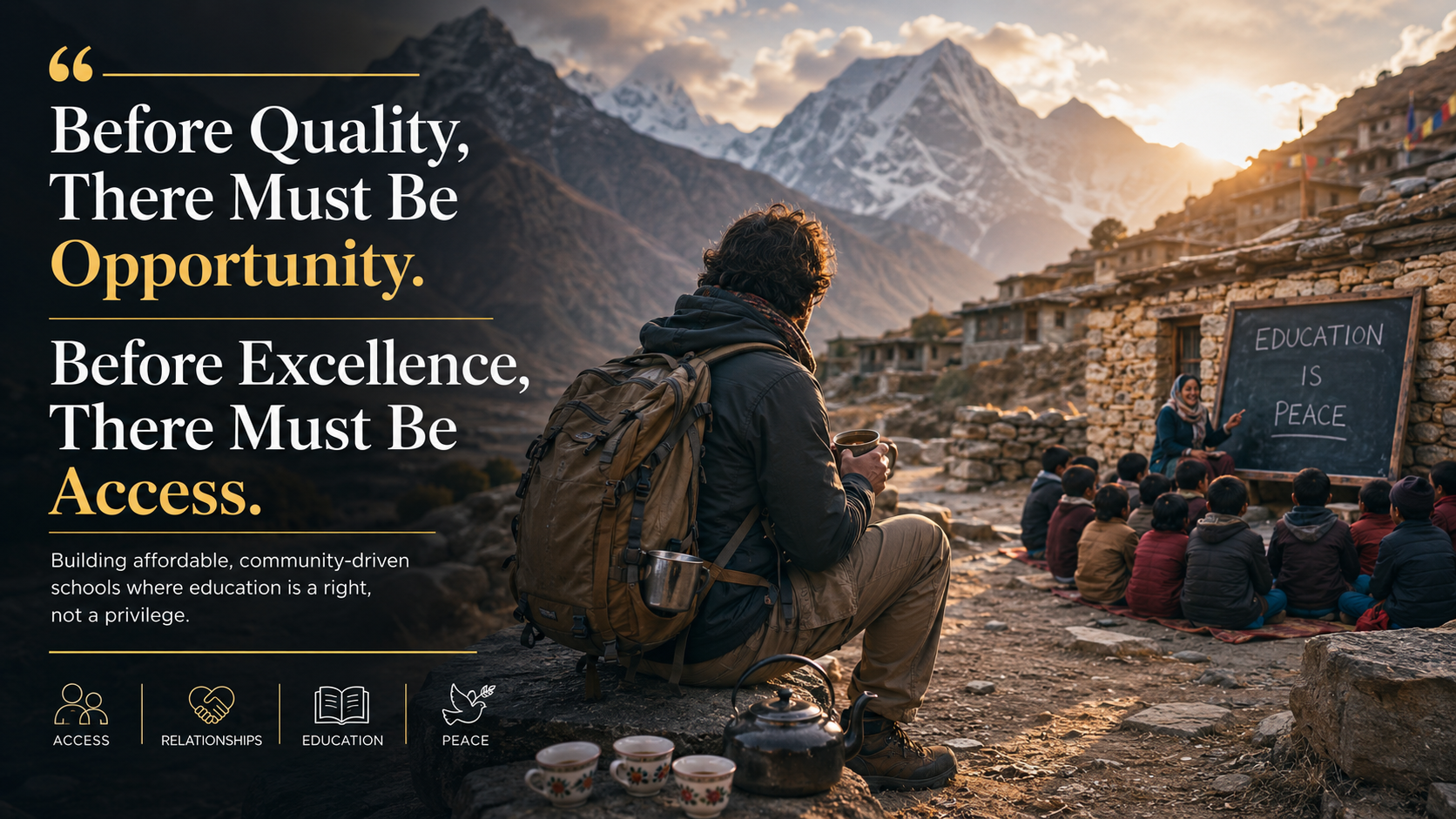
Before excellence, there must be access. A mountaineer’s accidental journey into a remote Pakistani village offers a lesson that India’s education debates urgently need — that a school must first be an invitation, not a privilege.
Sometimes being lost does not mean you are losing your way. Sometimes, it is simply another road through which God chooses to enter your life.
That is what Three Cups of Tea reminded me.
Greg Mortenson was a mountaineer, not an educationist. His dream was to conquer mountains, not build schools. He had never imagined dedicating his life to classrooms, children, or teachers. But life often writes its most meaningful chapters through — .
Lost in the harsh mountains after a failed attempt to summit K2, Greg stumbled into a remote village where strangers offered him shelter, warmth, and cups of tea. In that unfamiliar land, among people who had little, he found something immense—humanity. He saw children studying on bare ground, writing in dust, without walls, desks, or books. They desired a school with the kind of hunger that many of us reserve for survival itself.
And there, in that moment of helplessness and hospitality, he made a promise.
What began as one man, alone in the mountains, slowly became a movement. As he moved forward, he was no longer alone; he became surrounded by people who needed him, believed in him, and walked with him. He became, in a sense, a company—not of profit, but of purpose.
What is even more striking is that in places where education for girls was resisted, even some of his fiercest ideological opponents extended support when they saw his sincerity. That is the power of trust. That is the power of human relationships. Greg did not build schools merely with money; he built them with labour, patience, passion, and relentless dedication.
His story compels us to ask an important question: if one accidental journey into the mountains could build schools for those who needed them most, what might happen if more of us intentionally chose that path?
I recently finished reading Three Cups of Tea by Greg Mortenson—a book that begins not with success, but with failure. A failed mountain climb led Mortenson into a remote village in Pakistan, where he encountered children sitting on the cold ground, tracing lessons in the dirt because they had no school.
That image stayed with me.
Not because it was unfamiliar, but because it was painfully familiar.
Across India, and across much of the world, millions of children still stand at the edge of education—not because they lack intelligence, ambition, or potential, but because they lack access. We often speak about improving quality, reforming curriculum, training teachers, and modernising classrooms. These are important conversations. But they begin too late if we forget the first and most urgent truth:
Before quality, there must be opportunity.
Before excellence, there must be access.
This is where our educational debates often go wrong.
We measure school performance before asking whether a child can even enter one. We discuss learning outcomes while overlooking the cost of uniforms, transport, books, and fees that quietly exclude the poor. We demand excellence from systems that remain inaccessible to those who need them most.
The truth is simple: a child cannot benefit from quality education if education itself remains out of reach.
A school, therefore, must first be an invitation.
Not a privilege.
Not a luxury.
Not a gatekeeping institution.
But a place where every child—regardless of income, caste, geography, language, or ability—feels they belong.
Yet building schools is not merely about constructing buildings.
This is another lesson Three Cups of Tea teaches with remarkable force.
Greg Mortenson learned that infrastructure without relationships is fragile. Before laying bricks, he had to build trust. Before drawing blueprints, he had to drink tea—again and again—listening, learning, respecting.
This offers a profound educational truth:
Relationships are infrastructure.
A school is not cement and steel. It is trust between teachers and families. It is respect between communities and educators. It is the belief a child develops when someone says, “You matter enough for us to build this for you.”
Without trust, a school becomes a structure.
With trust, it becomes a sanctuary.
And perhaps the greatest lesson of all:
Education is peace-building.
We often think of peace as treaties, policies, or military deterrence. But peace begins much earlier—in classrooms.
A child who learns to read gains not just literacy, but agency.
A child who learns to question develops reason over rage.
A child who experiences dignity in school is less likely to seek power through violence.
The classroom can be a stronger weapon against hatred than armies.
Because armies can occupy land.
Only education can transform minds.
This is why building schools is not charity.
It is not philanthropy.
It is not social work.
It is nation-building.
Civilisation-building.
Future-building.
And this responsibility does not belong only to governments.
It belongs to teachers, communities, writers, professionals, and ordinary citizens.
Each of us can contribute—through money, time, resources, advocacy, mentorship, or vision.
Some can build walls.
Some can build libraries.
Some can build systems.
Some can build hope.
But all of us can help build access.
As an educator, I have come to believe that the future of schooling must be resource-rich but cost-light—where investment flows into teachers, learning materials, technology, and reading culture rather than unnecessary extravagance. A child needs books before branding. A teacher needs training before decorative campuses. Learning needs human warmth before institutional prestige.
If we truly want a better world, we must stop asking only how to improve schools.
We must ask:
Where are the children still waiting for one?
Because somewhere, right now, a child is studying under a tree.
Somewhere, a girl is walking miles because there is no classroom nearby.
Somewhere, a parent is choosing between food and school fees.
And somewhere, perhaps, there is someone reading this who has the power to change that.
Build the school.
Start small. Start local. Start imperfectly.
But start.
Because the world does not change when we produce a few excellent schools.
It changes when we make education accessible to all.
Perhaps the time has come for more of us to step forward—not to build expensive schools, but to build affordable, resource-rich, community-driven schools where education is not a privilege but a right. Because if one lost traveller could light thousands of futures, imagine what a collective commitment can do.
Join educators, students, professionals and researchers working together to build a Resource-Rich, Low-Cost School where every child has access to quality education.
Whether you teach, write, design, develop technology, conduct research or simply want to contribute your time, there is a meaningful role for you.