

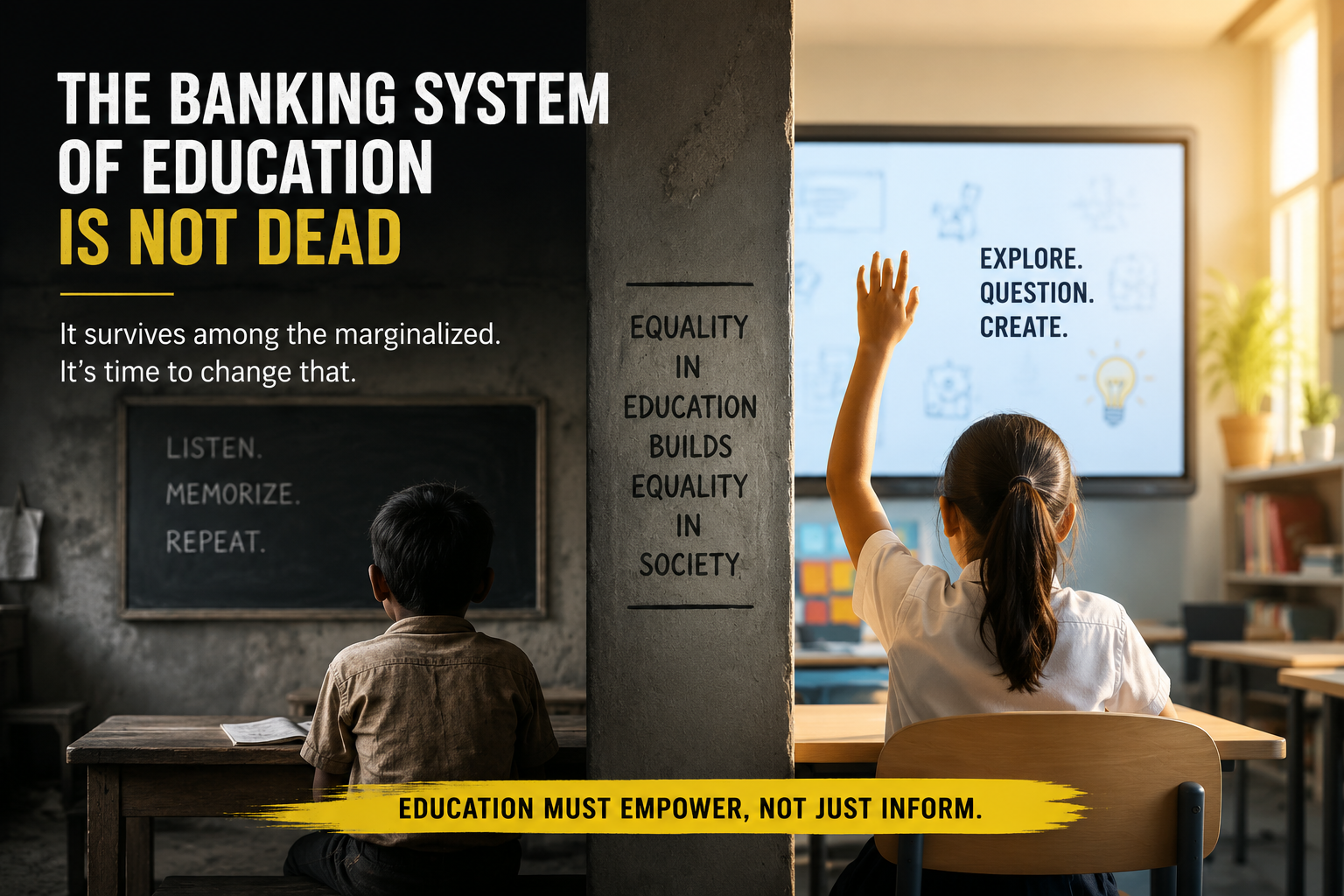
The Banking System of Education Is Not Dead: It Survives Among the Marginalized
Modern education celebrates transformation.
Across policy documents, private schools, and digital learning platforms, we hear of innovation, inquiry, critical thinking, creativity, and personalized learning. The classroom, we are told, is no longer a place where teachers “deposit” knowledge into passive learners. The world has moved, it seems, from the banking model of education toward self-exploration and learner autonomy.
But this shift is not universal.
For a significant section of society—the poorest, the most vulnerable, and the structurally marginalized—the banking system of education is not only alive; it remains the dominant reality.
And perhaps that is where its consequences are most dangerous.
The Unequal Death of the Banking Model
Paulo Freire criticized the banking concept of education as a system where students are treated like empty containers. Teachers deposit knowledge, students store it, and examinations demand its withdrawal.
To succeed is to remember.
To obey is to progress.
In many privileged schools today, this model is increasingly being challenged. Children are encouraged to ask questions, engage in projects, explore technology, collaborate, and construct knowledge. Their classrooms are rich with books, digital tools, trained teachers, and learning opportunities beyond textbooks.
But for the marginalized child, the story is very different.
The banking model has not disappeared.
It has simply been reserved for the poor.
The Classroom of Silence
Walk into many government schools or low-resource classrooms.
There you may find a child sitting quietly.
Listening.
Repeating.
Memorizing.
Not because the child lacks imagination, but because the system has trained silence as discipline and memorization as survival.
This child often comes from a household where educational expenditure competes with food, rent, medicine, and transport.
Books are expensive.
Private tuition is impossible.
Uniforms matter.
Attendance matters.
The mid-day meal matters.
School, for many such children, is not merely a place of learning. It is a place of sustenance.
A free uniform.
A free textbook.
A promise, however uncertain, of a better future.
And under such conditions, questioning becomes a luxury.
Listening becomes necessity.
The Difference Between Privilege and Poverty in Schooling
The contrast is not merely about infrastructure. It is about the kind of learner each system produces.
The marginalized child often learns to comply.
The privileged child experiments.
The marginalized child memorizes.
The privileged child is encouraged to challenge ideas.
The marginalized child is often expected to repeat them.
One enters the world as a creator.
The other enters as a receiver.
This is not because of ability.
It is because of access.
Exploratory learning requires conditions:
- time
- resources
- parental support
- literacy-rich homes
- safe spaces
- emotional security
For children burdened by economic uncertainty, these conditions are often absent.
Poverty does not only limit material resources.
It limits pedagogical freedom.
Education as Welfare, Not Liberation
For the poorest families, schooling often functions first as a welfare system.
It feeds.
It covers.
It accommodates.
And these are essential.
But when schooling becomes primarily a mechanism of welfare delivery, it risks becoming a system of maintenance rather than transformation.
Keep the child fed.
Keep the child occupied.
But not necessarily empowered.
This creates a dangerous educational duality:
One system develops agency.
The other manages dependency.
The Banking Logic Beyond the Classroom
There is another way to understand this.
In a financial bank, depositors store money. The bank then uses, circulates, and invests that money to generate profit. Depositors remain mostly passive, receiving only limited returns.
Education works similarly.
Students receive knowledge.
Institutions decide its use, legitimacy, and circulation.
Learners are allowed only limited withdrawal—usually in examinations.
But if learners become aware that knowledge is not meant to be stored, but used, reused, modified, and transformed, they stop being mere depositors.
This shift—from storing knowledge to using knowledge—is the foundation of educational freedom.
Yet for marginalized children, this transition is often denied.
What Must Be Done Differently?
If we want to dismantle the banking model where it hurts the most, reform must begin where inequality begins.
Not with elite innovation.
But with foundational justice.
This means:
- resource-rich but affordable schools
- reading-rich classrooms
- teacher development
- community participation
- parent literacy support
- digital access
- emotional safety
The goal is not to create expensive schools.
This is the philosophy behind our initiative, FEJI Academy.
A Different Possibility
At the heart of our work is a simple belief:
We need schools where children from economically weaker backgrounds do not merely receive education, but participate in it.
Where books are abundant.
Where teachers are supported.
Where technology extends learning.
Where AI assists understanding.
Where parents are included.
Where curiosity is not punished.
Where survival and learning do not compete.
A school does not need luxury buildings to produce meaningful education.
Invest in people.
Simplify buildings.
Digitize resources.
Automate administration.
Amplify learning.
That is the future.
The Real Question
The question is no longer whether the banking model exists.
It does.
The real question is:
And if the answer is the poorest child, then educational reform must begin there.
Because no society can claim educational progress while its most vulnerable learners are still being taught to store knowledge instead of transform it.
Education must not be a vault.
And for millions of marginalized children, that bridge is still waiting to be built.