

Someone Had To — Piece 02
The School Under the Bridge
He could not finish his own education. So when he saw children being denied theirs, he decided to do something about it.
New Delhi
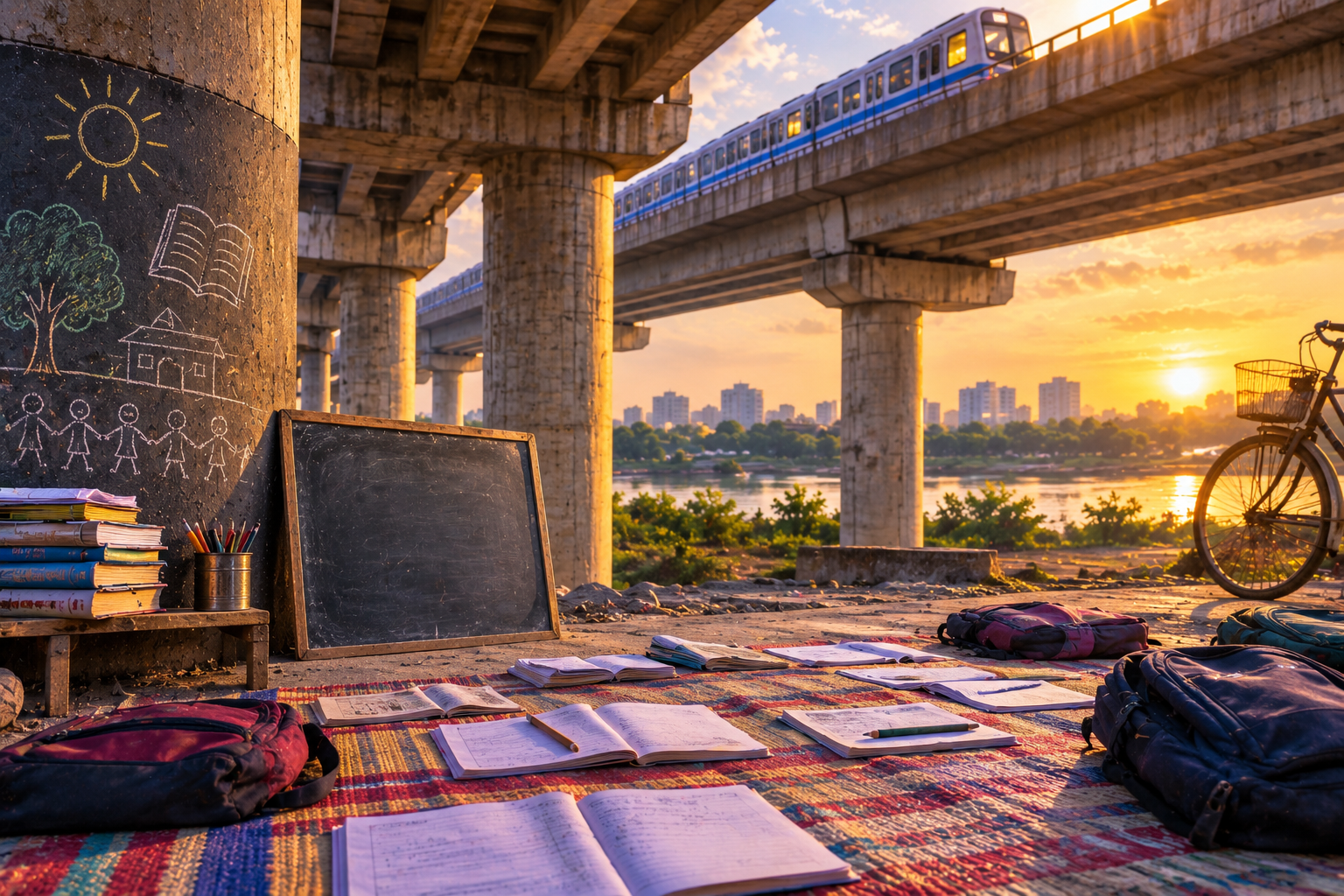
Every few minutes, a metro train passes overhead. Below it, children sit on mats with notebooks in their hands. Five blackboards are painted on a wall, and concrete pillars mark the boundaries of a classroom that has no conventional walls, roof, desks or benches. Yet the children come here every day, and they call the man who runs it Masterji. His name is Rajesh Kumar Sharma. He is not a government teacher, nor does he run a school as his profession — he is a shopkeeper who runs a small grocery store to support his family. But for nearly two decades, he has also been doing something else: helping children from some of Delhi’s poorest communities get an education. The story began because Sharma knew, personally, what it meant for poverty to stand between a child and a dream.
The Dream He Could Not Complete
Sharma grew up in a poor family in rural Uttar Pradesh, one of nine children. He wanted to study. His school was about seven kilometres from home, and getting there meant cycling for more than an hour; even so, he managed to complete high school, a significant achievement in his family. He later entered university, determined to continue his education and pursue his dream of becoming an engineer. To pay his registration fee, he sold his textbooks, and travelled more than 40 kilometres by bicycle and bus to attend classes. But after a year, his family could no longer afford to support his education, and he had to leave. The dream of becoming an engineer ended not because he had stopped wanting it, but because his circumstances had become stronger than his ambition. He moved to Delhi when he was about 20, sold watermelons, worked at construction sites, and did whatever work he could find, before eventually becoming a shopkeeper. Perhaps his own experience explains what happened next.
The Children He Could Not Ignore
While working around the Yamuna area, Sharma noticed the children of migrant workers and labourers — around the construction sites and fields, but not in school. At first he tried to help in the ways that came naturally, giving some children sweets and clothes. But something about the situation stayed with him: clothes could help for a day, food could help for a day, but education could change what came next. So, in 2006, Sharma began teaching two children under a tree. There was no building, no funding, no organisation — just two children, and a man who had once lost his own educational opportunity.
From Two Children to a School
The number of children gradually grew. When the elevated metro structure was built, the space beneath it became the setting for what came to be known as the Free School Under the Bridge. The surroundings were far from ideal — metro trains rattled overhead, children sat on the ground, donated mats became their seats, and walls became blackboards. But the school had something a building alone could not provide: people willing to give their time. Volunteer teachers began helping Sharma, and children began coming not only for basic learning but also for additional help with subjects such as mathematics, English, Hindi, science and social studies; many were already enrolled in government schools and came to Sharma’s school for extra support. By 2019, reports described around 300 children associated with the school, with boys and girls attending separate shifts and several local volunteers teaching without payment.2 The little school had become much bigger than the man who started it.
But Sharma Never Forgot the Real Goal
There is an important detail in this story: Sharma did not want children to remain permanently under the bridge. He wanted them to enter the formal education system, and helped children enrol in nearby government schools, encouraging families to take advantage of the education, books and meals available there. For children whose parents were migrants or informal workers and lacked the documents required for admission, he also helped with the paperwork. The bridge, therefore, was never meant to be the destination — it was a pathway, meant to help children move from being excluded from education to becoming part of it. There is evidence that this happened. In 2019, The Indian Express reported that around 30 students from the school had been enrolled into MCD and government schools that year, and that some former students had reached Delhi University while others had returned to help teach younger children.3 That is perhaps one of the most meaningful measures of what Sharma’s effort achieved: the children did not simply attend a school under a bridge. Some moved beyond it.
He Was Still a Shopkeeper
There is something quietly remarkable about Sharma’s story. He did not have unlimited resources, a large organisation, or freedom from the responsibilities of running a shop and supporting a family — yet he continued to give a substantial part of his time to the children. At one point, reports described him dedicating more than 50 hours a week to the school, which survived through a mixture of his own efforts, volunteers, and contributions from ordinary people who brought books, stationery and food, and who sometimes sat with the children beneath the bridge to celebrate their birthdays. These small gestures mattered for another reason. As Sharma himself observed, they made children feel that they too were part of society, regardless of where they lived or how much their families earned. That may be one of the most important parts of the story: education was not the only thing being offered. The children were being told, through everyday human interaction, that they belonged there too.
The Man Behind the School
Perhaps the most moving part of Sharma’s story is not the size of the school but the connection between his past and his work. He once wanted to become an engineer and could not. Years later, one of the children he first taught under a tree went on to university and wanted to become an engineer. Sharma once said that through these children, he gets to live the dream he could not complete himself — that he did not get another chance at his own dream, but could help someone else get theirs.
Recognition, Eventually
For years, the work continued with little more than local attention; then came wider recognition. In 2023, Rajesh Kumar Sharma received the Children’s Champion Award from the Delhi Commission for Protection of Child Rights (DCPCR), Government of NCT of Delhi, for providing additional educational support to children from under-resourced backgrounds.1 The recognition came seventeen years after he had begun with two children; by then, what had started as a personal response to a small problem had become a source of educational support for hundreds. But the award is not really the heart of the story. The heart lies much earlier.
Someone Had To
Sharma could not solve poverty. He could not change the circumstances of migrant workers, build schools across Delhi, or give every child a secure home and a financially comfortable family. But he could teach two children, so he did. Then there were more — and when those children needed help entering government schools, he helped them; when families lacked documents, he helped with those; when children needed additional teaching, he taught; when volunteers came, he made space for them; when ordinary people wanted to contribute, he accepted books, food and other useful things. He did not wait until he had enough resources to begin. He began with what he had.
Note
What the smallest response looks like
Sharma’s school did not begin as a plan to educate hundreds of children. It began with two, under a tree, with a man who remembered exactly what it felt like to lose an education. Everything that followed — the volunteers, the donations, the recognition — grew out of a decision that had already been made. The question his story leaves is not whether we can replicate its scale, but whether we are willing to begin at all: what is the smallest version of a problem we could start solving today, without waiting for permission, funding, or the right moment?
The Bridge Is Not the Story
It is tempting to remember this as a story about an unusual classroom — a school beneath a metro bridge makes a striking photograph. But the bridge is not really the story. The story is about a person who remembered what it felt like to be a poor child with a dream; about seeing children who were being left behind and refusing to regard their situation as someone else’s problem; about understanding that welfare does not always begin with a large institution or a government programme. Sometimes it begins with attention, then a little time, then a small act, and then another — and sometimes, if that act is sustained long enough, two children become hundreds. The question Sharma’s story leaves for the rest of us is therefore quite simple: what have we noticed around us that we have learned to call “not my responsibility”? Perhaps we cannot solve the whole problem. Perhaps we do not have money, authority or an organisation. But perhaps we have something else — a little time, a little knowledge, a little courage to begin. And sometimes, someone simply has to.
Someone had to.
Notes
- Delhi Commission for Protection of Child Rights (DCPCR), Government of NCT of Delhi, “Children’s Champion Award — Education Category,” 2023. dcpcr.delhi.gov.in ↩
- “Free School Under the Bridge,” Wikipedia, en.wikipedia.org; and The Better India, “This Grocery Store Owner Has Been Teaching over 300 Underprivileged Kids under a Bridge for a Decade,” thebetterindia.com. ↩
- The Indian Express, 2019, reporting on enrolment of the school’s students into MCD and government schools that year. ↩
- The UNESCO Courier, “The School Under a Bridge in New Delhi,” courier.unesco.org.
समवन हैड टू — भाग 02
पुल के नीचे का स्कूल
वे अपनी पढ़ाई पूरी नहीं कर पाए थे। इसलिए जब उन्होंने बच्चों को उनकी पढ़ाई से वंचित होते देखा, तो उन्होंने कुछ करने का फ़ैसला किया।
नई दिल्ली
हर कुछ मिनटों में, सिर के ऊपर से एक मेट्रो ट्रेन गुज़रती है। नीचे, बच्चे हाथों में कॉपियां लिए चटाइयों पर बैठे होते हैं। एक दीवार पर पांच ब्लैकबोर्ड बने हैं, और कंक्रीट के खंभे उस कक्षा की सीमाएं तय करते हैं, जिसकी कोई पारंपरिक दीवार, छत, डेस्क या बेंच नहीं है। फिर भी बच्चे यहां हर दिन आते हैं, और जो इंसान इसे चलाता है, वे उसे मास्टरजी कहकर बुलाते हैं। उनका नाम है राजेश कुमार शर्मा। वे कोई सरकारी शिक्षक नहीं हैं, न ही शिक्षण उनका पेशा है — वे एक दुकानदार हैं, जो अपने परिवार का पेट पालने के लिए एक छोटी सी किराने की दुकान चलाते हैं। लेकिन क़रीब दो दशकों से, वे एक और काम भी करते आ रहे हैं — दिल्ली के सबसे ग़रीब इलाक़ों के बच्चों को शिक्षा दिलाने में मदद करना। यह कहानी इसलिए शुरू हुई, क्योंकि शर्मा ख़ुद जानते थे कि जब ग़रीबी किसी बच्चे और उसके सपने के बीच आ जाती है, तो उसका क्या मतलब होता है।
वह सपना जो वे पूरा नहीं कर पाए
शर्मा उत्तर प्रदेश के एक गांव में एक ग़रीब परिवार में पले-बढ़े — नौ भाई-बहनों में से एक। वे पढ़ना चाहते थे। उनका स्कूल घर से क़रीब सात किलोमीटर दूर था, और वहां पहुंचने के लिए एक घंटे से ज़्यादा साइकिल चलानी पड़ती थी; फिर भी, उन्होंने हाई स्कूल पूरा किया, जो उनके परिवार के लिए एक बड़ी उपलब्धि थी। बाद में उन्होंने विश्वविद्यालय में दाख़िला लिया, अपनी पढ़ाई जारी रखने और इंजीनियर बनने का सपना पूरा करने की ठान कर। पंजीकरण फ़ीस भरने के लिए उन्होंने अपनी किताबें बेच दीं, और विश्वविद्यालय पहुंचने के लिए साइकिल और बस से 40 किलोमीटर से ज़्यादा का सफ़र तय करते थे। लेकिन एक साल बाद, उनका परिवार उनकी पढ़ाई का ख़र्च नहीं उठा सका, और उन्हें पढ़ाई छोड़नी पड़ी। इंजीनियर बनने का सपना इसलिए ख़त्म नहीं हुआ क्योंकि उन्होंने चाहना बंद कर दिया था — बल्कि इसलिए क्योंकि उनके हालात उनकी महत्वाकांक्षा से ज़्यादा मज़बूत साबित हुए। वे क़रीब 20 साल की उम्र में दिल्ली आ गए, तरबूज़ बेचे, निर्माण-स्थलों पर काम किया, और जो भी काम मिला वह किया, इससे पहले कि वे आख़िरकार एक दुकानदार बन गए। शायद उनका अपना अनुभव ही बताता है कि आगे क्या हुआ।
वे बच्चे जिन्हें वे नज़रअंदाज़ नहीं कर पाए
यमुना इलाक़े में काम करते हुए, शर्मा ने प्रवासी मज़दूरों और मज़दूर परिवारों के बच्चों को देखा — निर्माण-स्थलों और खेतों के आसपास घूमते हुए, लेकिन स्कूल से दूर। शुरुआत में, उन्होंने वही करने की कोशिश की जो स्वाभाविक लगा, बच्चों को मिठाई और कपड़े देना। लेकिन इस स्थिति की कोई बात उनके मन में अटकी रही: कपड़े एक दिन के लिए मदद कर सकते थे, खाना एक दिन के लिए मदद कर सकता था, लेकिन शिक्षा यह बदल सकती थी कि आगे क्या होगा। तो, 2006 में, शर्मा ने एक पेड़ के नीचे दो बच्चों को पढ़ाना शुरू किया। न कोई इमारत थी, न फ़ंडिंग, न कोई संगठन — बस दो बच्चे, और एक ऐसा इंसान जो कभी अपना शिक्षा का मौक़ा खो चुका था।
दो बच्चों से एक स्कूल तक
बच्चों की संख्या धीरे-धीरे बढ़ती गई। जब मेट्रो का ऊंचा ढांचा बना, तो उसके नीचे की जगह उस स्कूल का ठिकाना बन गई, जो आगे चलकर ‘फ़्री स्कूल अंडर द ब्रिज’ के नाम से जाना गया। माहौल आदर्श से बहुत दूर था — सिर के ऊपर से मेट्रो ट्रेनें गड़गड़ाहट के साथ गुज़रतीं, बच्चे ज़मीन पर बैठते, दान में मिली चटाइयां उनकी सीटें बन गईं, और दीवारें ब्लैकबोर्ड बन गईं। लेकिन इस स्कूल के पास वह चीज़ थी, जो सिर्फ़ एक इमारत नहीं दे सकती थी — ऐसे लोग जो अपना समय देने को तैयार थे। स्वयंसेवक शिक्षक शर्मा की मदद करने लगे, और बच्चे अब सिर्फ़ बुनियादी पढ़ाई के लिए नहीं, बल्कि गणित, अंग्रेज़ी, हिंदी, विज्ञान और सामाजिक विज्ञान जैसे विषयों में अतिरिक्त मदद के लिए भी आने लगे; कई बच्चे पहले से ही सरकारी स्कूलों में दाख़िल थे और अतिरिक्त सहारे के लिए शर्मा के स्कूल आते थे। 2019 तक, रिपोर्टों के अनुसार इस स्कूल से क़रीब 300 बच्चे जुड़े हुए थे, जहां लड़के और लड़कियां अलग-अलग पालियों में आते थे, और कई स्थानीय स्वयंसेवक बिना किसी भुगतान के पढ़ाते थे।2 यह छोटा सा स्कूल उस इंसान से कहीं बड़ा हो चुका था, जिसने इसे शुरू किया था।
लेकिन शर्मा असली मक़सद कभी नहीं भूले
इस कहानी में एक ज़रूरी बात छुपी है: शर्मा नहीं चाहते थे कि बच्चे हमेशा के लिए पुल के नीचे ही रह जाएं। वे चाहते थे कि बच्चे औपचारिक शिक्षा व्यवस्था का हिस्सा बनें, और इसके लिए उन्होंने बच्चों को आस-पास के सरकारी स्कूलों में दाख़िला दिलाने में मदद की, परिवारों को वहां मिलने वाली शिक्षा, किताबों और भोजन का फ़ायदा उठाने के लिए प्रोत्साहित किया। जिन बच्चों के माता-पिता प्रवासी या अनौपचारिक मज़दूर थे और जिनके पास दाख़िले के लिए ज़रूरी काग़ज़ात नहीं थे, उनके लिए उन्होंने काग़ज़ी कार्रवाई में भी मदद की। इसलिए पुल कभी मंज़िल नहीं था — वह एक रास्ता था, जिसका मक़सद बच्चों को शिक्षा से बाहर होने की स्थिति से निकालकर उसका हिस्सा बनाना था। इस बात के प्रमाण भी मिलते हैं कि ऐसा हुआ। 2019 में, दी इंडियन एक्सप्रेस ने रिपोर्ट किया कि उस साल स्कूल के क़रीब 30 छात्रों को एमसीडी और सरकारी स्कूलों में दाख़िला मिला, और यह भी बताया कि कुछ पुराने छात्र दिल्ली विश्वविद्यालय तक पहुंचे, जबकि कुछ छोटे बच्चों को पढ़ाने में मदद करने के लिए वापस लौट आए।3 शायद यही शर्मा की कोशिश की सबसे सार्थक कसौटी है: बच्चे सिर्फ़ पुल के नीचे बने स्कूल में नहीं आते रहे। कुछ इससे आगे भी बढ़े।
वे अब भी एक दुकानदार थे
शर्मा की कहानी में एक बात चुपचाप असाधारण है। उनके पास असीमित साधन नहीं थे, कोई बड़ा संगठन उनके पीछे नहीं था, और न ही उन्हें दुकान चलाने और परिवार पालने की ज़िम्मेदारियों से कोई छूट थी — फिर भी वे अपने समय का एक बड़ा हिस्सा बच्चों को देते रहे। एक समय पर, रिपोर्टों के अनुसार वे हफ़्ते में 50 घंटे से ज़्यादा समय इस स्कूल को देते थे, और यह स्कूल उनकी अपनी कोशिशों, स्वयंसेवकों और आम लोगों के योगदान के मेल से चलता रहा, जो किताबें, स्टेशनरी और खाना लेकर आते, और कभी-कभी बच्चों के साथ पुल के नीचे बैठकर उनके जन्मदिन मनाते। इन छोटे-छोटे इशारों की एक और वजह से भी अहमियत थी। जैसा कि शर्मा ने ख़ुद देखा, इनसे बच्चों को यह महसूस होता कि वे भी समाज का हिस्सा हैं — चाहे वे कहीं भी रहते हों या उनके परिवार कितना भी कमाते हों। शायद यह कहानी का सबसे अहम हिस्सा है: शिक्षा ही अकेली चीज़ नहीं थी जो दी जा रही थी। बच्चों को रोज़मर्रा के इंसानी व्यवहार के ज़रिए यह बताया जा रहा था कि वे भी यहीं के हैं।
स्कूल के पीछे का इंसान
शायद शर्मा की कहानी का सबसे छूने वाला हिस्सा इस स्कूल का आकार नहीं, बल्कि उनके अतीत और उनके काम के बीच का रिश्ता है। वे कभी इंजीनियर बनना चाहते थे और नहीं बन पाए। बरसों बाद, जिन बच्चों को उन्होंने सबसे पहले एक पेड़ के नीचे पढ़ाया था, उनमें से एक विश्वविद्यालय तक पहुंचा और इंजीनियर बनना चाहता है। शर्मा ने एक बार कहा था कि इन बच्चों के ज़रिए, वे वह सपना जी पाते हैं जिसे वे ख़ुद पूरा नहीं कर सके थे — कि उन्हें अपने सपने के लिए दूसरा मौक़ा नहीं मिला, लेकिन वे किसी और को उसका सपना पाने में मदद कर सके।
पहचान, आख़िरकार
बरसों तक, यह काम बस स्थानीय ध्यान के साथ चलता रहा; फिर व्यापक पहचान मिली। 2023 में, राजेश कुमार शर्मा को दिल्ली सरकार के दिल्ली कमीशन फ़ॉर प्रोटेक्शन ऑफ़ चाइल्ड राइट्स (DCPCR) की ओर से चिल्ड्रन्स चैंपियन अवॉर्ड मिला, कमज़ोर तबक़ों के बच्चों को अतिरिक्त शैक्षणिक सहारा देने के लिए।1 यह पहचान दो बच्चों से शुरुआत करने के सत्रह साल बाद आई; तब तक, एक छोटी सी समस्या के जवाब में शुरू हुआ यह निजी प्रयास, सैकड़ों बच्चों के लिए शैक्षणिक सहारे का ज़रिया बन चुका था। लेकिन यह पुरस्कार असल में इस कहानी का मूल नहीं है। कहानी का मूल कहीं पहले है।
किसी को तो करना ही था
शर्मा ग़रीबी ख़त्म नहीं कर सकते थे। वे प्रवासी मज़दूरों के हालात नहीं बदल सकते थे, पूरी दिल्ली में स्कूल नहीं बना सकते थे, या हर बच्चे को एक सुरक्षित घर और आर्थिक रूप से मज़बूत परिवार नहीं दे सकते थे। लेकिन वे दो बच्चों को पढ़ा सकते थे, तो उन्होंने पढ़ाया। फिर और बच्चे आए — और जब उन बच्चों को सरकारी स्कूलों में दाख़िले के लिए मदद चाहिए हुई, तो उन्होंने मदद की; जब परिवारों के पास काग़ज़ात नहीं थे, तो उन्होंने उसमें मदद की; जब बच्चों को अतिरिक्त पढ़ाई की ज़रूरत हुई, तो उन्होंने पढ़ाया; जब स्वयंसेवक आए, तो उन्होंने उनके लिए जगह बनाई; जब आम लोग योगदान देना चाहते थे, तो उन्होंने किताबें, खाना और अन्य ज़रूरी चीज़ें स्वीकार कीं। उन्होंने इतने साधन जमा होने का इंतज़ार नहीं किया कि वे शुरुआत कर सकें। उन्होंने जो कुछ उनके पास था, उसी से शुरुआत की।
टिप्पणी
सबसे छोटी शुरुआत कैसी दिखती है
शर्मा का स्कूल सैकड़ों बच्चों को पढ़ाने की किसी बड़ी योजना के रूप में शुरू नहीं हुआ था। यह एक पेड़ के नीचे, दो बच्चों के साथ शुरू हुआ था — एक ऐसे इंसान के साथ, जिसे बख़ूबी याद था कि शिक्षा खोना कैसा महसूस होता है। बाद में जो कुछ भी हुआ — स्वयंसेवक, दान, पहचान — वह सब उस फ़ैसले के बाद आया, जो पहले ही लिया जा चुका था। उनकी कहानी जो सवाल छोड़ जाती है, वह इसके पैमाने को दोहराने का नहीं, बल्कि शुरुआत करने की इच्छा का है: किसी समस्या का सबसे छोटा रूप क्या है, जिसे हम आज ही सुलझाना शुरू कर सकते हैं — बिना अनुमति, फ़ंडिंग या सही मौक़े का इंतज़ार किए?
पुल यह कहानी नहीं है
इसे एक अनोखी कक्षा की कहानी की तरह याद रखना आसान लगता है — मेट्रो के पुल के नीचे बना एक स्कूल एक प्रभावशाली तस्वीर बनाता है। लेकिन असल में यह कहानी उस पुल की नहीं है। यह उस इंसान की कहानी है, जिसे याद था कि एक ग़रीब बच्चे का सपना देखना कैसा महसूस होता है; यह उन बच्चों को देखने और उनकी स्थिति को ‘किसी और की समस्या’ मानने से इनकार करने की कहानी है, जो पीछे छूटते जा रहे थे; यह इस बात को समझने की कहानी है कि कल्याण हमेशा किसी बड़ी संस्था या सरकारी योजना से शुरू नहीं होता। कभी-कभी यह ध्यान देने से शुरू होता है, फिर थोड़े से समय से, फिर एक छोटे से क़दम से, फिर एक और क़दम से — और कभी-कभी, अगर यह क़दम काफ़ी देर तक जारी रहे, तो दो बच्चे सैकड़ों में बदल जाते हैं। तो शर्मा की कहानी हम सबके लिए जो सवाल छोड़ जाती है, वह काफ़ी सीधा है: हमने अपने आस-पास ऐसा क्या देखा है, जिसे हमने “यह मेरी ज़िम्मेदारी नहीं है” कहकर टाल दिया? शायद हम पूरी समस्या हल नहीं कर सकते। शायद हमारे पास पैसा, अधिकार या कोई संगठन नहीं है। लेकिन शायद हमारे पास कुछ और है — थोड़ा सा समय, थोड़ी सी जानकारी, शुरुआत करने का थोड़ा सा साहस। और कभी-कभी, किसी को तो करना ही होता है।
किसी को तो करना ही था।
टिप्पणियां
- दिल्ली कमीशन फ़ॉर प्रोटेक्शन ऑफ़ चाइल्ड राइट्स (DCPCR), दिल्ली सरकार, “चिल्ड्रन्स चैंपियन अवॉर्ड — शिक्षा श्रेणी,” 2023। dcpcr.delhi.gov.in ↩
- “फ़्री स्कूल अंडर द ब्रिज,” विकिपीडिया, en.wikipedia.org; तथा द बेटर इंडिया, “दिस ग्रोसरी स्टोर ओनर हैज़ बीन टीचिंग ओवर 300 अंडरप्रिविलेज्ड किड्स अंडर अ ब्रिज फ़ॉर अ डिकेड,” thebetterindia.com। ↩
- दी इंडियन एक्सप्रेस, 2019, स्कूल के छात्रों के एमसीडी और सरकारी स्कूलों में उस वर्ष हुए दाख़िलों की रिपोर्ट। ↩
- द यूनेस्को कूरियर, “द स्कूल अंडर अ ब्रिज इन न्यू दिल्ली,” courier.unesco.org।