

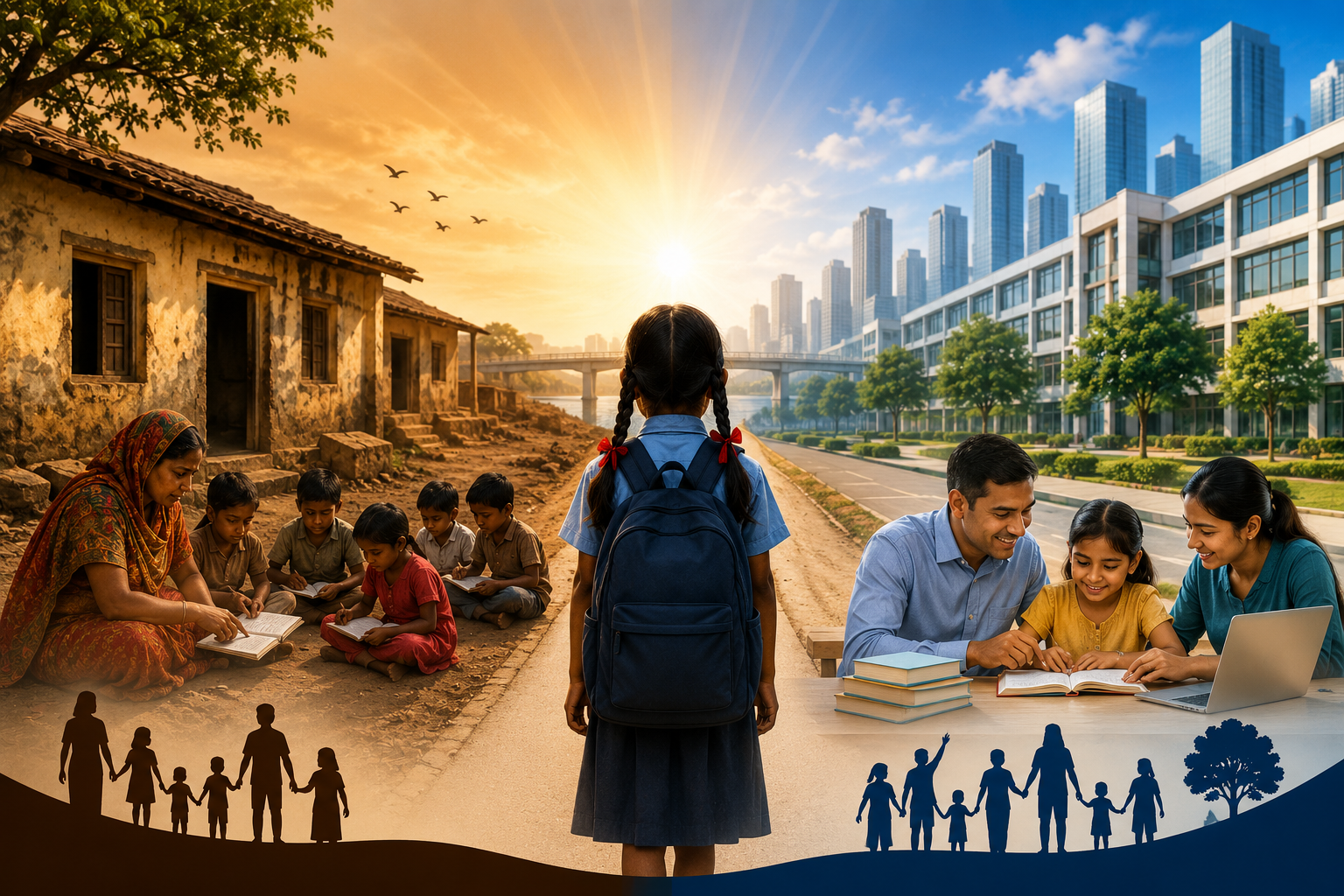
India’s Schooling Future Depends on Adult Literacy and Community-Centered Schools
India expanded access. China consolidated quality. The next phase of Indian schooling must rethink structure, literacy, and community.
For decades, India’s educational success has been measured by expansion—more schools, more enrolment, more schemes, and more access. In many ways, this expansion has been historic.
Today, India has nearly 1.47 million schools, more than three times the number of schools in China, which has approximately 440,000. Yet China, with a comparable—and in many contexts larger—school-age population, continues to outperform India in literacy, learning outcomes, and foundational competencies.
This contrast raises a difficult but necessary question: if India has more schools, why does learning remain weaker?
The answer lies in structure.
Access vs Competence
India built for access. China built for competence.
India’s schooling system evolved around neighborhood accessibility. Through the Right to Education Act, mid-day meal schemes, inclusion policies, and large-scale enrolment campaigns, the country ensured that millions of children entered classrooms. This was a major achievement, especially for rural and marginalized populations.
But this model also created a highly fragmented schooling landscape—small schools, scattered teacher deployment, uneven supervision, and thinly spread resources.
A rough enrolment-to-school ratio suggests Indian schools serve around 170 learners per institution compared to over 600 in China, indicating far greater institutional fragmentation in India.
Fewer schools have allowed China to consolidate investment—stronger infrastructure, better-trained teachers, tighter accountability, and more consistent curriculum implementation.
The result is not simply better schools; it is a more manageable schooling system.
The Missing Variable: Adult Literacy
But there is another factor, often overlooked in educational policy: adult literacy.
China’s adult literacy rate stands at around 97%, while India’s remains close to 81.7%. This gap is not just statistical; it is generational.
Adult literacy directly shapes the home learning environment. Literate parents read to children, monitor homework, understand school expectations, and engage with teachers. They become co-educators.
In India, nearly 18–19% of adults remain outside formal literacy. Among the poorest households, this number is often far higher.
For these families, education is not a choice—it is hope. Often, one child becomes the family’s only bridge to a more dignified future.
That child carries not only personal aspiration but the collective dream of an entire household.
The Literacy Vacuum at Home
And yet, this child often returns home to a literacy vacuum.
- No books.
- No reading support.
- No academic guidance.
- No informed parent-school engagement.
In such contexts, the school must do more than teach the child.
It must teach the family.
Where Reform Must Begin
If schools want better child outcomes, they must invest in parent literacy, parent training, and parent-school partnerships.
A school cannot remain an isolated institution operating only between morning assembly and the final bell. It must become a community knowledge center.
This is particularly urgent for low-income communities where parental educational disadvantage continues to reproduce child disadvantage.
A Different School Model
A resource-rich, low-cost school model offers an important possibility—not only by improving learning within the classroom, but also by extending support beyond it.
School initiatives do not depend solely on expensive infrastructure. Instead, they focus on what matters most:
- Strengthening teacher quality
- Expanding digital resources
- Improving foundational literacy systems
- Building structured curricula
- Deepening community outreach
Their success lies not in grand buildings, but in creating strong human and learning ecosystems.
Parent Outreach as Core Strategy
In this model, parent outreach is not an optional extension—it is central.
- Adult literacy circles for parents
- Reading workshops for mothers
- Parent orientation for homework support
- Community libraries
- Digital literacy sessions
- Home-reading programs
When parents learn, children learn better.
When communities become literate, schools become stronger.
The Real Goal of Schooling
The long-term goal of schooling must expand beyond child enrolment. It must aim at intergenerational transformation.
China’s schooling success demonstrates the power of structural concentration and literate communities.
India’s future will depend on adapting this lesson to its own realities—not by copying China, but by recognizing that educational quality is built not only in classrooms, but in homes.
The next phase of Indian schooling cannot simply be about opening more schools.
It must be about building stronger schools, stronger homes, and stronger communities. Because for millions of India’s poorest children, school is not just a place to study.
It is the family’s only path to light.