

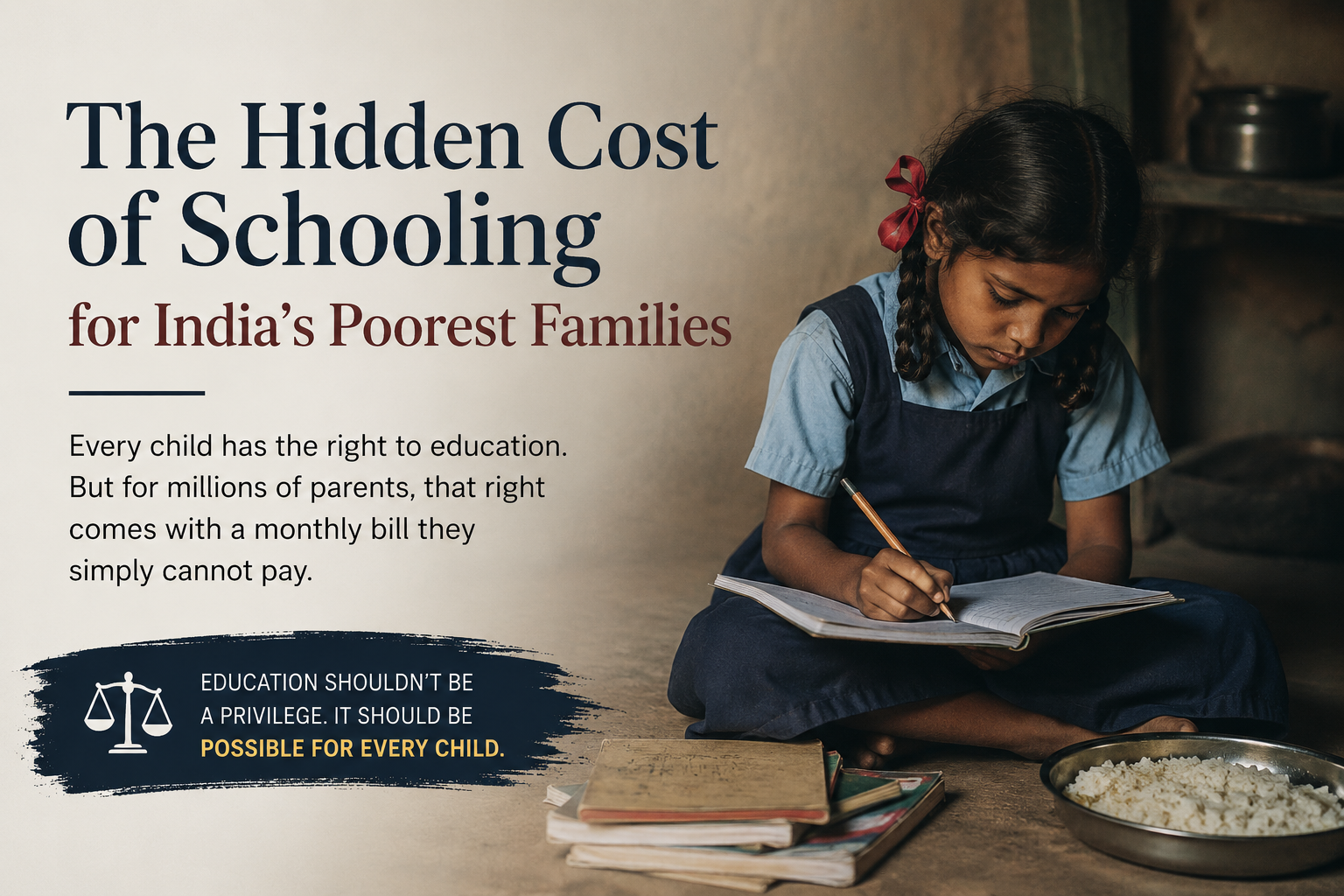
The Hidden Cost of Schooling for India’s Poorest Families
“Free” government schooling still consumes 16–35% of monthly family income — turning education into a monthly competition with food, fuel and medicine.
Every child has the right to education. Yet for millions of Indian parents, that right comes with a monthly bill they simply cannot afford. Behind every school uniform, notebook, and examination fee lies a difficult choice—one that often forces families to balance education against food, medicine, and survival itself.
A Child Should Never Have to Compete with a Plate of Rice
Every morning, millions of parents send their children to school carrying hopes far heavier than the school bag on their child’s shoulders. They dream of giving their children a life that they themselves never experienced—a life where education opens doors to dignity, opportunity, and financial security. Like every parent, they want their children to succeed. Yet before those dreams can take shape, they must answer a question that no parent should ever have to ask: can we afford to keep our children in school this month?
For middle-class families, education is generally viewed as a planned investment. School fees, books, uniforms, and transportation are incorporated into the monthly household budget. For poor families, however, education is rarely an assured investment. Instead, it becomes a series of painful compromises. Every notebook purchased may mean fewer vegetables at home. Every school uniform may require postponing the purchase of medicines. Examination fees may come at the cost of delaying rent or cooking gas. Education, in such households, competes directly with survival.
This silent struggle seldom appears in educational debates. Discussions about learning outcomes, digital education, artificial intelligence, and curriculum reforms often dominate policy conversations. Yet India’s own official household surveys quietly reveal that for millions of families, the greatest educational challenge is not learning quality—it is simply finding enough money to keep children in school.
Poverty Looks Different When Measured Child by Child
India’s economic progress is frequently celebrated through national averages. Rising GDP, increasing literacy rates, and expanding educational infrastructure create an encouraging national picture. However, averages often conceal the reality experienced by those living at the bottom of the economic ladder.
According to the Household Consumption Expenditure Survey (HCES) 2023–24, the average monthly per capita consumption expenditure in rural India is approximately ₹4,122. In Bihar, one of India’s economically weaker states, this figure falls further to around ₹3,670 per person each month. While these numbers themselves indicate financial constraints, they still represent averages that combine the consumption patterns of both relatively better-off and poorer households.
| Segment | Per capita / month | 5-member household |
|---|---|---|
| Bottom 5% | ₹1,639 | ₹8,195 |
| Bottom 10% | ₹2,099 | ₹10,495 |
| Bottom 20% | ₹2,447 | ₹12,235 |
| Rural Bihar average | ₹3,670 | — |
| Rural India average | ₹4,122 | — |
The situation becomes far more concerning when we examine the poorest segments of the population. These figures are not discretionary spending; they represent the total amount available to meet every essential need of daily life. From this limited budget, families must purchase food, pay rent, buy cooking fuel, arrange transportation, purchase medicines, pay electricity bills, recharge mobile phones, buy clothing, and meet unavoidable social and emergency expenses. Education does not receive a separate allocation within this budget. It must compete with every other basic necessity required for survival.
Income Tells an Even More Difficult Story
While household consumption reveals how families survive, household income explains why survival itself remains so difficult. Recent analyses based on India’s Periodic Labour Force Survey (PLFS) and the Consumer Pyramids Household Survey (CPHS) indicate that households in the poorest income decile often earn only ₹3,100 to ₹4,200 per month.
It is important to recognise that this amount represents the total monthly income of an entire household rather than the earnings of a single individual. Financial experts generally recommend that households should not spend more than 15 to 20 percent of their income on any one category if they wish to maintain financial stability. For these families, this translates into a realistic educational budget of only ₹500 to ₹800 per month.
This amount, however, is not available for one child alone. In many poor households, there are three, four, or even five school-going children. Once the available educational budget is divided among multiple children, the amount that can be spent on each child becomes extremely small. Consequently, poor parents are rarely able to compare schools based on educational quality. Instead, they are compelled to ask a much more painful question: which child can we realistically afford to educate?
Government Schools Are Not Truly Free
Government schools are widely described as providing free education. While tuition fees may not be charged, education is by no means costless for poor families. According to the Comprehensive Modular Survey: Education (2025), households with children enrolled in rural government schools still spend approximately ₹2,639 per child annually, or about ₹220 every month, on uniforms, notebooks, stationery, transportation, examination fees, and other educational necessities.
For many middle-income households, an expenditure of ₹220 per month may appear insignificant. However, its significance changes dramatically when viewed from the perspective of a household earning only ₹3,100 to ₹4,200 each month.
| Household | Monthly schooling cost | Share of income |
|---|---|---|
| 3 children in govt. school | ₹660 | 16–21% |
| 5 children in govt. school | ₹1,100 | 26–35% |
After paying these unavoidable schooling costs, families must still arrange food, housing, medicines, electricity, transportation, clothing, and every other household necessity from the remaining income. Moreover, these calculations do not include private tuition, digital devices, internet connectivity, replacement uniforms, school bags, or other incidental educational expenses that frequently arise throughout the academic year.
Viewed from this perspective, the remarkable question is not why some poor children discontinue their education. Rather, it is astonishing that millions of economically disadvantaged parents continue making extraordinary sacrifices to keep their children in school.
Why Government Schools Become the Only Practical Choice
Public discussions often assume that parents simply choose between government and private schools based on preference. In reality, the choice for poor families is rarely voluntary. Official survey data indicate that the annual expenditure on a child attending a private school is approximately seven times higher than that for a child enrolled in a government school in rural India. Similar differences are observed in urban areas.
For families already struggling to arrange ₹220 every month for government schooling, the costs associated with private education lie far beyond their financial capacity. The decision is therefore not between a good school and a better school. It is a choice between some education and no education at all.
This financial reality explains why official educational statistics consistently show that children from poorer households are overwhelmingly concentrated in government schools, while enrolment in private schools increases steadily with household income. Government schools therefore perform a far greater function than merely providing education; they preserve educational access for millions of families who would otherwise be excluded entirely.
Poverty Does Not Reduce Aspirations
A common misconception is that poor parents place little importance on education. The lived reality suggests precisely the opposite. Families living in poverty continue purchasing notebooks despite financial hardship. They borrow money to buy school uniforms, postpone medical treatment to pay examination fees, and often enrol their children in low-cost private schools despite severe financial strain because they believe education offers the only path towards a better future.
These decisions cannot be understood purely as financial calculations. They represent acts of hope. Parents who struggle to meet their own basic needs continue investing in their children’s education because they believe tomorrow can be different from today. Poverty limits their choices, but it does not diminish their aspirations.
Education is competing with survival
When policymakers or educational institutions describe a monthly school fee of ₹500 or ₹1,000 as affordable, affordability is often evaluated from the perspective of middle-income households. For the poorest families, affordability has an entirely different meaning.
Education does not compete with entertainment, holidays, or luxury spending. It competes with food, medicines, cooking fuel, and other basic necessities. Every school fee paid may mean purchasing fewer vegetables that month. Every notebook bought may require postponing medical treatment. Every examination fee may delay the purchase of essential household items. Within the economics of poverty, educational expenditure is rarely an additional expense; it replaces another equally essential necessity.
The myth of the affordable school
Across India, numerous schools advertise themselves as low-cost or affordable institutions. Yet affordability is always relative. A school charging ₹1,500 per month may indeed be inexpensive for an urban middle-class household. For a family earning only ₹4,000 per month, however, such a fee is financially impossible.
Furthermore, tuition fees represent only one component of educational expenditure. Uniforms, books, stationery, transportation, school shoes, annual functions, examination charges, digital learning resources, and private tuition collectively increase the overall cost of schooling. Each individual expense may appear manageable in isolation. Together, they create an overwhelming financial burden that many poor households simply cannot sustain.
Poor parents do not withdraw their children from school because they underestimate the value of education. They withdraw them because mathematics eventually overpowers aspiration.
India Does Not Need Cheaper Schools. It Needs Smarter Schools.
If India’s poorest families can realistically devote only ₹500 to ₹800 per month towards educating all of their children, educational policy must begin with that economic reality. The challenge is not merely reducing school fees. The real challenge is increasing educational quality while simultaneously reducing educational costs.
Achieving this objective requires a fundamentally different school model:
- High-quality teaching supported by technology rather than replaced by it
- Digital learning resources substituting expensive printed materials wherever appropriate
- Open Educational Resources to significantly reduce textbook costs
- Artificial intelligence assisting teachers in lesson preparation, assessment, and personalised learning
- Community volunteers, retired teachers, university students, and local professionals contributing expertise without proportionately increasing costs
- Efficient school administration redirecting resources away from bureaucracy and towards learning itself
In essence, India requires resource-rich, low-cost schools—schools where educational quality is generated through innovation, collaboration, and intelligent use of technology rather than through higher fees.
The Question Before India
Public debates often frame educational reform as a choice between government schools and private schools. For millions of poor parents, however, that is not the real question. Their concern is much simpler and far more fundamental: can all of my children receive a good education without pushing our family deeper into poverty?
Until India’s education system is capable of answering that question, poverty—not talent, intelligence, or determination—will continue deciding which children gain access to quality education and which children merely receive schooling.
No parent should ever have to choose between feeding a child today and educating that child for tomorrow. And no child’s future should be determined by the size of the family’s monthly income rather than by the child’s potential.