

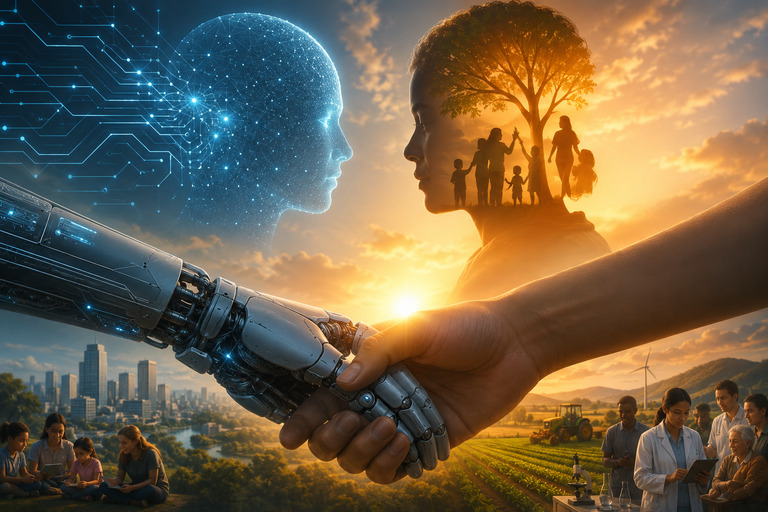
From Artificial Intelligence to Human Good
AI is growing fast, but fast growth is not the same as good growth. Right now it spreads like a weed — in every direction at once, indifferent to what the garden actually needs. The real question is not whether it will keep growing. It will. The question is whether we shape that growth, or let it run wild.
AI has moved fast. It writes, translates, diagnoses, designs, teaches, and predicts. Businesses use it to work faster, governments are testing it, scientists use it to speed up research, and ordinary people now use it for tasks that once took years to learn. But speed and quality are different things, and AI is spreading everywhere without much agreement on what it should actually do for us.
This is not an argument to slow AI down out of fear, nor to speed it up out of excitement. Growth without direction is not real progress — it is just expansion. What is needed instead is a clear way to guide that growth, and I would sort it into three ideas: positivism, altruism, and workaholism.
01Positivism: Believing AI Can Help, and Proving It
Most conversation about AI falls into two camps — people too excited about it, and people too frightened of it — and both tend to miss the point. A better starting point is positivism, which is not blind faith in the technology. It is a simple, working belief: AI can make life better, if it is built the right way.
Take education. A child in a small village may never meet a genuinely good teacher; a teacher may be handling several crowded classes with no real time to prepare. These are ordinary, everyday problems, and AI cannot fix them on its own — but it can help close the gap. It can translate lessons into local languages, generate practice material, and give a shy student somewhere to ask a question without fear of judgement. The same logic extends to healthcare, farming, disaster response, and small business, all places where good advice has traditionally been scarce and expensive.
What separates positivism from mere hype is the question it asks. It does not assume AI is good by default; it asks how to make it good — a question of design, not marketing. Looking at AI only through fear makes us good at spotting risk and poor at recognising possibility. Positivism is a reminder that AI is not simply happening to us. It remains something we can still shape.
02Altruism: Asking Who Actually Benefits
Believing AI can help is not, on its own, enough — belief says nothing about who actually receives that help. A tool can make a company a great deal of money while making life worse for the people who need help the most. That outcome is not success; it is simply profit.
This is where altruism enters the picture — pointing AI toward human welfare rather than speed or profit alone, which changes the questions asked at every stage. Instead of “can we build it,” the question becomes “who will it help.” Instead of “how much faster is this,” it becomes “how much real trouble does it solve.” Instead of “how much money does this make,” it becomes “does this open new doors for people.”
None of this makes profit a bad thing — profit funds new ideas, and business has a genuine part to play. But profit cannot be the only measure of success. If AI remains usable only by the wealthy and by well-funded schools, the gap between them and everyone else widens rather than narrows. The larger promise of AI is that it can hand ordinary people tools once locked away for the rich and powerful: a small shop owner gaining the kind of data tools a large company already has, a teacher gaining something like a planning assistant, a farmer gaining expert-level advice without paying an expert. Altruism is what keeps that promise alive, rather than letting money alone decide where AI ends up going.
03Workaholism: The Hard Work of Actually Building It
Belief and good intentions build nothing on their own. Wanting to help a poor school does not, by itself, produce the tool that helps it; wanting to help farmers does not, by itself, create a working app for them. Someone has to actually build the thing, test it, watch it fail, fix it, and try again.
That steady, unglamorous work is what I would call workaholism — not burnout, and not working until something breaks, but staying with a problem and testing it repeatedly until it genuinely works for real people. A teacher has to work out how AI fits into an actual, imperfect classroom rather than an ideal one. An engineer has to make a system run on cheap, ageing computers. A researcher has to test whether AI actually helps rather than merely appears to. A policymaker has to find a way to reach the people who are usually left out of these rollouts. None of this happens quickly. It happens through the slow work of people who refuse to accept the gap between what AI could do and what it actually does.
04Why All Three Have to Work Together
Three Ideas, One Direction
Belief AI Can Help
Without altruism: progress with no real purpose.
Who Actually Benefits
Without workaholism: good intentions that never become real.
The Hard Work
Without positivism: hard work with no clear goal.
Each idea fails when left alone. Positivism without altruism gives progress with no real purpose; altruism without workaholism gives good intentions that never turn into anything real; workaholism without positivism gives hard work with no clear goal; and positivism without workaholism leaves us talking about AI’s potential forever, without ever building it.
“A plant left alone does not become a garden. It becomes a mess.”
This is the pruning that is needed right now. Growth alone is not a sign of health. So anyone using AI in their field — teacher, doctor, engineer, farmer, business owner — should not simply race to use it faster than everyone else. They should cut away the parts that help no one, and grow the parts that matter. Before adopting any AI tool, three simple questions are worth asking.
- Do we believe this can really help, and have we built it to actually help?
- Who exactly will benefit, and does the design genuinely reach them?
- Are we ready for the slow work of making it actually work, not just look good in a demo?
05What Should Really Count
Big changes in history were never decided by the tool itself. The printing press did not decide what people would print. The internet did not decide what people would say. AI will not decide what we value — we decide that, and we always have.
The real measure of this AI age will not be how many parameters a model has, or how fast it answers.
The real measure is simpler than that. Did a child get better access to learning? Did a teacher get more time to teach? Did a doctor treat more patients? Did a farmer get better advice? Did an ordinary person gain tools once kept for experts only? If the answer keeps being yes, AI will have done something bigger than being smart — it will have been shaped, on purpose, into something good for people.
The Point of the Pruning
AI does not need to be slowed down out of fear, or rushed forward out of excitement. It needs to be shaped — cut back where it helps no one, and grown deliberately where it genuinely matters.
The tool was never going to decide what we value. That has always been, and remains, our decision to make.
आर्टिफ़िशियल इंटेलिजेंस से इंसानों की भलाई तक
AI बहुत तेज़ी से बढ़ रहा है, मगर तेज़ी से बढ़ना और अच्छी तरह बढ़ना, दोनों अलग बातें हैं। फ़िलहाल ये एक जंगली घास की तरह फैल रहा है — हर तरफ़, बिना ये सोचे कि बाग़ को असल में क्या चाहिए। असली सवाल ये नहीं कि ये बढ़ता रहेगा या नहीं — ये बढ़ेगा ही। असली सवाल ये है कि क्या हम इसे सही शक्ल देंगे, या इसे यूँ ही जंगली छोड़ देंगे।
AI बहुत तेज़ी से आगे बढ़ा है। ये लिखता है, तर्जुमा करता है, बीमारी पहचानता है, डिज़ाइन बनाता है, पढ़ाता है, और अंदाज़ा लगाता है। कंपनियाँ इसे तेज़ी से काम करने के लिए इस्तेमाल कर रही हैं, सरकारें इसे आज़मा रही हैं, साइंटिस्ट इससे अपनी रिसर्च तेज़ कर रहे हैं, और आम लोग अब उन कामों के लिए भी इसका इस्तेमाल कर रहे हैं जिन्हें सीखने में पहले सालों लग जाते थे। लेकिन रफ़्तार और क्वालिटी दो अलग बातें हैं, और AI हर जगह फैल रहा है बिना इस बात पर कोई साफ़ राय बने कि इसे असल में हमारे लिए करना क्या चाहिए।
ये बात डर की वजह से AI को धीमा करने की दलील नहीं है, और न ही जोश में आकर इसे और तेज़ करने की दलील है। बिना किसी दिशा के बढ़ना असली तरक़्क़ी नहीं होती — वो बस फैलाव होता है। इसकी बजाय हमें इस बढ़ोतरी को सही राह दिखाने का एक साफ़ तरीक़ा चाहिए, और मैं इसे तीन बातों में बाँटता हूँ — पॉज़िटिविज़्म (उम्मीद भरा यक़ीन), ऑल्ट्रूइज़्म (बेग़र्ज़ भलाई), और वर्कहॉलिज़्म (लगातार मेहनत)।
01पॉज़िटिविज़्म: ये यक़ीन कि AI मदद कर सकता है, और इसे साबित करना
AI को लेकर ज़्यादातर बातचीत दो गुटों में बँट जाती है — कुछ लोग बहुत ज़्यादा उत्साहित हैं, और कुछ लोग बहुत ज़्यादा डरे हुए हैं, और दोनों ही असल बात चूक जाते हैं। इससे बेहतर शुरुआत है पॉज़िटिविज़्म, जिसका मतलब AI पर आँख मूँदकर भरोसा करना नहीं है। इसका मतलब है एक सीधा-सा यक़ीन — कि अगर इसे सही तरीक़े से बनाया जाए, तो AI ज़िंदगी को बेहतर बना सकता है।
पढ़ाई को ही ले लीजिए। एक छोटे से गाँव के बच्चे को शायद कभी कोई अच्छा टीचर न मिले; किसी टीचर को इतनी भरी हुई क्लासें संभालनी पड़ती हैं कि तैयारी के लिए वक़्त ही नहीं बचता। ये रोज़मर्रा की आम सच्चाइयाँ हैं, और AI इन्हें अकेले हल नहीं कर सकता — मगर ये उस कमी को कम करने में ज़रूर मदद कर सकता है। ये पाठों का स्थानीय भाषा में तर्जुमा कर सकता है, अभ्यास के लिए सामग्री बना सकता है, और किसी शर्मीले बच्चे को बिना डरे सवाल पूछने की जगह दे सकता है। यही बात सेहत, खेती-किसानी, आपदा में मदद, और छोटे कारोबार पर भी लागू होती है, जहाँ अच्छी सलाह हमेशा से मुश्किल से मिलती रही है और महंगी भी।
पॉज़िटिविज़्म को सिर्फ़ हाइप से अलग करने वाली बात ये है कि ये कौन-सा सवाल पूछता है। ये ये नहीं मान लेता कि AI अपने-आप अच्छा है। ये पूछता है — इसे अच्छा कैसे बनाया जाए? ये सवाल डिज़ाइन का है, मार्केटिंग का नहीं। अगर हम AI को सिर्फ़ डर की नज़र से देखेंगे, तो हम ख़तरे पहचानने में तो माहिर हो जाएँगे, मगर नए मौक़े ढूँढने में कमज़ोर रह जाएँगे। पॉज़िटिविज़्म हमें याद दिलाता है कि AI कोई ऐसी चीज़ नहीं जो बस हमारे साथ हो रही है — बल्कि ये अब भी एक ऐसी चीज़ है जिसे हम अपनी मर्ज़ी से शक्ल दे सकते हैं।
02ऑल्ट्रूइज़्म: ये पूछना कि असल में फ़ायदा किसे हो रहा है
सिर्फ़ ये यक़ीन रखना कि AI मदद कर सकता है, काफ़ी नहीं है — ये यक़ीन ये नहीं बताता कि वो मदद असल में किसे मिलेगी। कोई टूल किसी कंपनी को ख़ूब पैसा कमा सकता है, जबकि उन लोगों की ज़िंदगी और मुश्किल बना सकता है जिन्हें सबसे ज़्यादा मदद की ज़रूरत है। ये कामयाबी नहीं है — ये बस मुनाफ़ा है।
यहीं पर ऑल्ट्रूइज़्म काम आता है — AI का रुख़ इंसानों की भलाई की तरफ़ मोड़ना, न कि सिर्फ़ रफ़्तार या मुनाफ़े की तरफ़, और इससे हमारे सवाल पूछने का तरीक़ा ही बदल जाता है। “क्या हम इसे बना सकते हैं” पूछने के बजाय, हम पूछते हैं “इससे फ़ायदा किसे होगा।” “ये कितना तेज़ है” पूछने के बजाय, हम पूछते हैं “ये असल में कितनी बड़ी परेशानी हल करता है।” “इससे कितना पैसा बनता है” पूछने के बजाय, हम पूछते हैं “क्या ये लोगों के लिए नए दरवाज़े खोलता है।”
इसका मतलब ये नहीं कि मुनाफ़ा कमाना बुरी बात है — मुनाफ़े से ही नए आइडियाज़ को पैसा मिलता है, और कारोबार की भी अपनी असली भूमिका है। लेकिन मुनाफ़ा ही कामयाबी नापने का इकलौता पैमाना नहीं हो सकता। अगर सिर्फ़ अमीर लोग और अमीर स्कूल ही AI इस्तेमाल कर पाएँ, तो उनके और बाक़ी सबके बीच का फ़ासला घटने की बजाय और बढ़ जाएगा। AI का असली वादा ये है — ये आम लोगों को वो टूल दे सकता है जो पहले सिर्फ़ अमीर और ताक़तवर लोगों तक सीमित थे। एक छोटा दुकानदार भी वैसे ही डेटा टूल पा सकता है जैसे किसी बड़ी कंपनी के पास होते हैं। एक टीचर को पाठ की तैयारी में ऐसी मदद मिल सकती है जैसे उसके पास एक असिस्टेंट हो। एक किसान बिना किसी माहिर को पैसे दिए, एक्सपर्ट जैसी सलाह पा सकता है। ऑल्ट्रूइज़्म ही इस वादे को ज़िंदा रखता है, वरना सिर्फ़ पैसा ये तय करने लगेगा कि AI किस दिशा में जाए।
03वर्कहॉलिज़्म: इसे असल में बनाने की मेहनत
सिर्फ़ यक़ीन और नेक इरादे अपने-आप कुछ नहीं बनाते। किसी ग़रीब स्कूल की मदद करने की चाहत, वो टूल नहीं बना देती जो उसकी मदद करे। किसानों की मदद करने की चाहत, उनके लिए काम करने वाला ऐप नहीं बना देती। किसी को असल में वो चीज़ बनानी पड़ती है, उसे टेस्ट करना पड़ता है, उसे नाकाम होते देखना पड़ता है, उसे ठीक करके फिर से आज़माना पड़ता है।
इसी मुश्किल और लगातार चलने वाली मेहनत को मैं वर्कहॉलिज़्म कहता हूँ — इसका मतलब ख़ुद को थका देना या टूट जाने तक काम करना नहीं है, बल्कि किसी समस्या पर डटे रहना, उसे बार-बार आज़माते रहना, जब तक कि वो असली लोगों के लिए सच में काम न करने लगे। एक टीचर को ये समझना पड़ता है कि AI किसी असली, अधूरी-सी क्लास में कैसे फ़िट होता है, ना कि किसी परफ़ेक्ट क्लास में। एक इंजीनियर को इस सिस्टम को सस्ते, पुराने कंप्यूटरों पर भी चलाना पड़ता है। एक रिसर्चर को ये टेस्ट करना पड़ता है कि AI असल में मदद कर रहा है, या बस मदद करता हुआ दिख रहा है। एक पॉलिसी बनाने वाले को उन लोगों तक पहुँचने का रास्ता खोजना पड़ता है जो आमतौर पर पीछे छूट जाते हैं। ये सब कुछ जल्दी नहीं होता। ये उन लोगों की धीमी, बिना किसी चमक-दमक वाली मेहनत से होता है जो ये मानने को तैयार नहीं कि AI जो कर सकता है, और जो वो असल में करता है — इन दोनों के बीच का फ़ासला यूँ ही रहने दिया जाए।
04तीनों बातों का साथ होना क्यों ज़रूरी है
तीन बातें, एक दिशा
ये यक़ीन कि AI मदद कर सकता है
ऑल्ट्रूइज़्म के बिना: ऐसी तरक़्क़ी जिसका कोई असली मक़सद नहीं।
फ़ायदा असल में किसे
वर्कहॉलिज़्म के बिना: नेक इरादे जो कभी हक़ीक़त नहीं बनते।
असली मेहनत
पॉज़िटिविज़्म के बिना: ऐसी मेहनत जिसकी कोई साफ़ मंज़िल नहीं।
ये तीनों बातें अकेले-अकेले नाकाम हो जाती हैं। ऑल्ट्रूइज़्म के बिना पॉज़िटिविज़्म हमें ऐसी तरक़्क़ी देता है जिसका कोई असली मक़सद नहीं होता; वर्कहॉलिज़्म के बिना ऑल्ट्रूइज़्म हमें सिर्फ़ नेक इरादे देता है जो कभी हक़ीक़त नहीं बनते; पॉज़िटिविज़्म के बिना वर्कहॉलिज़्म हमें ऐसी मेहनत देता है जिसकी कोई साफ़ मंज़िल नहीं होती; और वर्कहॉलिज़्म के बिना पॉज़िटिविज़्म हमें हमेशा के लिए सिर्फ़ AI की संभावनाओं की बातें करते रहने देता है, बिना उसे कभी बनाए।
“अगर किसी पौधे को यूँ ही छोड़ दिया जाए, तो वो बाग़ नहीं बनता, बल्कि उलझी हुई झाड़ियाँ बन जाता है।”
यही वो छंटाई है जो अभी हमें चाहिए। सिर्फ़ बढ़ते जाना सेहतमंद होने की निशानी नहीं है। इसलिए जो भी अपने क्षेत्र में AI इस्तेमाल कर रहा है — चाहे वो टीचर हो, डॉक्टर हो, इंजीनियर हो, किसान हो, या कारोबारी हो — उसे बस दूसरों से पहले इस्तेमाल करने की होड़ में नहीं भागना चाहिए। उसे उन हिस्सों को काटना चाहिए जिनसे किसी को कोई फ़ायदा नहीं होता, और उन हिस्सों को बढ़ाना चाहिए जो असल में मायने रखते हैं। कोई भी AI टूल इस्तेमाल करने से पहले, ये तीन आसान सवाल मदद करते हैं।
- क्या हमें सच में यक़ीन है कि ये मदद कर सकता है, और क्या हमने इसे वाक़ई मदद करने के लिए बनाया है?
- इससे फ़ायदा असल में किसे होगा, और क्या इसका डिज़ाइन सच में उन तक पहुँचता है?
- क्या हम वो धीमी मेहनत करने को तैयार हैं जिससे ये असल में काम करे, न कि सिर्फ़ किसी डेमो में अच्छा दिखे?
05असल में क्या मायने रखना चाहिए
इतिहास में बड़े बदलाव कभी किसी औज़ार ने ख़ुद तय नहीं किए। छापेखाने ने ये तय नहीं किया कि लोग क्या छापेंगे। इंटरनेट ने ये तय नहीं किया कि लोग क्या कहेंगे। AI भी ये तय नहीं करेगा कि हमारे लिए क्या मायने रखता है — ये फ़ैसला हम करते हैं, हमेशा से हमीं करते आए हैं।
इस AI के दौर को नापने का असली पैमाना ये नहीं होगा कि किसी मॉडल में कितने पैरामीटर हैं, या वो कितनी तेज़ी से जवाब देता है।
असली पैमाना कहीं ज़्यादा सीधा-सा है। क्या किसी बच्चे को पढ़ाई तक बेहतर पहुँच मिली? क्या किसी टीचर को पढ़ाने के लिए ज़्यादा वक़्त मिला? क्या किसी डॉक्टर ने ज़्यादा मरीज़ों का इलाज किया? क्या किसी किसान को बेहतर सलाह मिली? क्या किसी आम इंसान को वो टूल मिले जो पहले सिर्फ़ माहिरों के लिए ही होते थे? अगर इन सब सवालों का जवाब हाँ होता रहा, तो समझिए AI ने सिर्फ़ ‘होशियार’ होने से कहीं बड़ी बात कर दिखाई होगी — इसे जान-बूझकर, इंसानों की भलाई के लिए, एक सही शक्ल दी गई होगी।
छंटाई की असली बात
AI को डर की वजह से धीमा करने की या जोश में आकर और तेज़ करने की ज़रूरत नहीं है। इसे एक सही शक्ल देने की ज़रूरत है — जहाँ से किसी को फ़ायदा नहीं, वहाँ से इसे काटा जाए, और जहाँ असल में फ़र्क़ पड़ता है, वहाँ इसे जान-बूझकर बढ़ाया जाए।
ये औज़ार कभी ये तय नहीं करने वाला था कि हमारे लिए क्या मायने रखता है। ये फ़ैसला हमेशा से हमारा था, और आज भी हमारा ही है।