

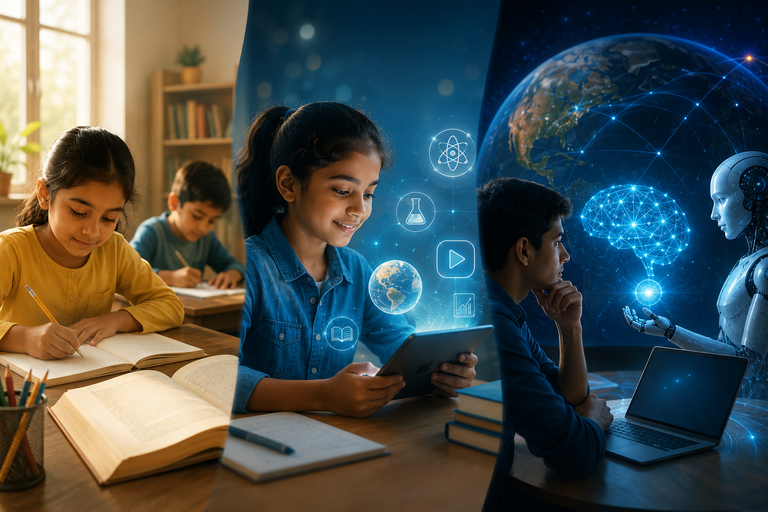
Build the Brain with Paper. Expand the Brain with Digital. Empower the Brain with AI.
Education has spent years debating an unnecessary question — should children learn from books or from screens? The answer is neither. What learners actually need is a carefully staged progression that uses each medium where it contributes most.
The future of education does not belong to paper alone, nor does it belong to screens alone. It belongs to a deliberate sequence that matches each medium to the stage of learning it serves best. That sequence can be stated simply: build the brain with paper, expand the brain with digital, and empower the brain with AI. This is not a slogan so much as a roadmap — one grounded in how children actually develop, and in what each medium can and cannot do at a given age.
The Four-Phase Roadmap
- Preschool – Grade 3Build the Brain with PaperCognitive development: letters, handwriting, fine motor skills, reading fluency, vocabulary, attention, imagination.
- Grades 4–5Build Digital HabitsA transition phase: digital confidence, keyboarding, online safety, digital citizenship — alongside, not instead of, print.
- Grade 6 OnwardsExpand the Brain with DigitalDigital becomes the principal medium: analysis, investigation, collaboration, and access to a constantly updated world of resources.
- OngoingEmpower the Brain with AIA personal learning assistant that adapts, explains, and gives feedback — extending, not replacing, the teacher.
01Build the Brain with Paper
The first years of schooling should belong almost entirely to paper, and for good reason: children in this window are not merely learning subjects, they are building the brain’s underlying architecture. Between preschool and Grade 3, learners are recognising letters, developing handwriting, strengthening fine motor skills, acquiring reading fluency, building vocabulary, sustaining attention, developing imagination, and — perhaps most importantly — cultivating the habit of reading itself.
Paper carries genuine cognitive advantages during this period. A printed page lets a child focus without the pull of digital distraction; writing by hand strengthens memory and the neural connections that support it; and a physical book encourages the kind of sustained, immersive reading that builds deep engagement with a story. The goal of these early grades is not technological proficiency — it is cognitive development. A strong reader can go on to learn almost anything; a weak reader struggles across every subject for years afterward. That asymmetry alone is reason enough for paper to remain the dominant medium through the foundational years.
02Building Digital Habits, With Purpose
Two common mistakes recur across education systems: introducing technology far too early, before foundational literacy exists, or postponing it until secondary school and then expecting digital competence to appear overnight. Both create avoidable problems. Grades 4 and 5 are better understood as a deliberate transition phase, in which paper remains an important resource even as students gradually begin using digital devices in meaningful, structured ways.
These two years should be about building digital confidence rather than replacing the textbook outright. Over this period, learners can reasonably be expected to develop the responsible use of smartphones and tablets, comfort with digital reading and keyboarding, an understanding of online safety, the ability to search for reliable information, familiarity with dictionaries and translation tools, and the basics of creating a digital document, joining an online lesson, and using an educational app. The underlying aim is to make technology a tool for learning rather than merely a source of entertainment — so that by the end of Grade 5, every learner has the confidence and the basic skills to learn effectively in a digital environment.
03A Digital-First Education, from Grade 6
From Grade 6 onward, the primary medium of learning should shift from printed textbooks to digital resources. This does not mean eliminating books; it means changing the principal vehicle through which knowledge reaches the student. By this stage, learners are expected to analyse, investigate, communicate, collaborate, and solve problems — activities that digital technology tends to support considerably better than a printed textbook on its own.
A single device, at this point, can carry textbooks, reference works, dictionaries, encyclopaedias, educational videos, virtual laboratories, simulations, interactive assessments, language tools, coding environments, collaborative platforms, and current information from anywhere in the world. Unlike a printed book, digital material can be updated instantly, enriched with multimedia, and distributed to millions of learners at almost no additional cost — which is precisely why education, from this stage forward, should become digital-first, opening access to a continuously expanding body of knowledge rather than a fixed edition that ages the moment it is printed.
04Empowering Learning with AI
Digital access is only the beginning. Artificial intelligence represents the next real transformation, giving every learner something close to a personal learning assistant — one that explains concepts, answers questions, offers practice, adapts to individual pace, translates content across languages, and provides immediate feedback. Rather than replacing the teacher, AI extends their reach: the teacher continues to inspire, mentor, and guide, while AI personalises instruction at a scale no traditional classroom has been able to achieve on its own. The classroom this points toward is not one teacher and forty identical learners working through identical material, but one teacher supported by tools that let each learner progress according to their own needs.
05Adulthood Needs Both, Not Either
Although schooling should become progressively digital-first from Grade 6 onward, adult learning does not follow the same logic. Adults read for many different purposes — novels, biographies, philosophy, history, research papers, professional manuals, online courses, technical documentation, blogs, and journals — and some of that reading remains genuinely more rewarding in print, while other material is simply more efficient in digital form. Printed books stay unmatched for reflective reading and sustained intellectual immersion; digital resources offer speed, searchability, collaboration, and continuous updating that print cannot match. The lifelong learner’s task is not to choose one medium over the other permanently, but to choose whichever medium actually serves the purpose of a given moment of learning.
06Why the Transition Also Makes Economic Sense
Education has to be pedagogically sound, but it also has to be economically sustainable, and the two considerations happen to point in the same direction here.
Two Cost Structures
Printed Textbooks Require
- Paper, printing, binding
- Warehousing & transport
- Reprinting on every curriculum change
- Physical storage in schools and homes
Digital Resources Offer
- Near-instant distribution at scale
- Updates with no reprinting
- Thousands of books on one device
- Video, assessment & translation tools built in
Every new edition of a printed textbook consumes fresh paper, fresh printing runs, and fresh money. Digital material, once created, can reach millions of learners almost instantly, and an update requires no reprinting at all. For education systems working with limited budgets, that difference represents a genuine opportunity to expand access while reducing the recurring costs that printed material carries year after year.
07The Smartphone as the World’s Largest Classroom
Billions of people already carry a powerful learning device in their pocket. The smartphone is among the most widely distributed technologies in human history, and yet its educational potential remains largely untapped — for most learners, it is still associated primarily with social media, gaming, and entertainment rather than learning. The more useful question for educators is not how to keep children away from their phones, but how to turn every phone into a genuine learning companion. A learner equipped with real digital literacy can reach world-class educational resources regardless of geography, income, or the state of their school’s own infrastructure. The opportunity, in that sense, already exists; what remains is building the habits and skills to use it wisely.
“Build the Brain with Paper. Build Digital Habits with Purpose. Expand the Brain with Digital. Empower the Brain with AI.”
08Towards a New Educational Culture
Schools should not produce children who fear technology, nor children who depend on it without understanding it. What they should produce are learners who know when to reach for paper, when to reach for a digital tool, and when to rely on AI — a sequence that begins with paper, continues through digital literacy, and culminates in intelligent, lifelong learning.
The Philosophy
The future of education is not paperless, and it is not screen-dominated either. It is developmentally appropriate, economically sustainable, and technologically empowering — each medium given the stage of learning where it does the most good.
If children can be guided through these stages thoughtfully, they will be prepared not just for examinations, but for a lifetime of learning in a world where knowledge is increasingly digital, intelligence is increasingly augmented, and the ability to keep learning is the most valuable skill of all.