

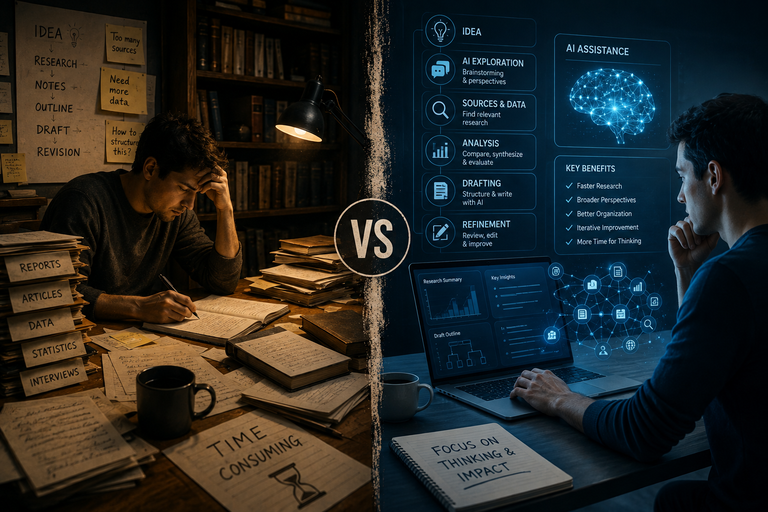
When AI Writes, Who Is Thinking?
AI can now write an article faster than most humans. But that fact hides a wrong assumption — that writing is only about putting words together. Before any words appear, there is wondering, questioning, doubting, and deciding. That journey belongs to the human. AI can join it. AI cannot own it.
If a machine can write well, what is left for the human writer to do? The question hides a wrong assumption — that writing is only about putting words together. But writing is more than that. Before any words appear, there is wondering, questioning, reading, comparing, doubting, and deciding. The finished article is only the last step of a much longer journey, and that journey belongs to the human. AI can join it. AI cannot own it.
AI has not only changed the last step of writing. It has opened a new way to do the whole journey. There is a big difference between asking AI to write for us and asking AI to think with us. The first makes AI the author. The second keeps the human as the author, and makes AI a helper.
01The One-Shot Writer
Think about the simplest way people use AI. A person has an idea, maybe just one line, and types it in — “write an article about the impact of AI on education.” In seconds, a full article appears, complete with an introduction, arguments, examples, and a neat conclusion. The words may sound better than anything the person could write alone. They fix a typo or two, and publish it.
Here, AI has become a content machine. The human gives the topic; AI gives almost everything else, and very little human thought goes into the final piece. This is a bit like using a calculator — when adding two large numbers, we do not do the sums by hand if a calculator is near; we give the numbers, we take the answer. Writing can work the same way at its simplest. But this is only the surface. There is a deeper way to use AI, and in that deeper way, the balance of work shifts back toward the human.
02The Conversation Begins
Now imagine something different. A person has a rush of ideas about a topic — messy, sometimes contradictory, sometimes wrong, but a few new and worth exploring, even if not yet clear. This messiness is the raw material of real thinking, and only a human starts with it. They begin talking to AI, explaining what they are thinking. AI expands the possibilities. The person pushes back. AI offers another view. The person asks for proof. AI points to reports, studies, and opposing arguments. Every one of these steps still needs a human choice — AI opens doors, and the human decides which one to walk through.
The person follows those leads, opens the reports, reads the real material. They find that one of AI’s explanations was incomplete, and they fix it. They find a number that changes how they see the problem, and they write it down. They come back to AI with the new fact, and the conversation keeps going — at every turn, it is the human who is testing, checking, and correcting. Something different is happening now: the person is not asking AI to write. They are using AI to think, and the thinking itself stays in human hands.
Two Ways to Use AI
The One-Shot Writer
One prompt in, one finished article out. AI does almost everything; very little human thought enters the final piece.
The Conversation
A long back-and-forth. AI opens doors; the human tests, checks, and decides which one to walk through, every time.
03From Finding Information to Exploring Ideas
This difference matters because AI can remove much of the friction between having an idea and exploring it. In the past, a researcher had to search databases, find the right papers, open each report, read hundreds of pages, and pull out the useful parts before they could even begin to build an argument. AI can speed up many of these steps — searching, aligning scattered data into one place, summarising long documents, comparing one report against another. But speed does not mean giving up responsibility. A careful researcher asks AI to point to good sources, then goes straight to those sources; the original report still matters, the real data still matters, the full context still matters, and the researcher checks what AI said against what the source actually says.
This creates a clear division of labour, worth stating plainly. AI can find, sort, and align knowledge — it can pull out numbers and line up facts for comparison. But the human decides whether that knowledge is true, whether it is meaningful, and what it means for the argument being built. This matters because AI can sound confident and still be wrong. As AI grows more powerful, human checking may matter more, not less.
04The Notebook Still Matters
There is something almost strange about this process. A person may use one of the most advanced AI tools ever built, and still keep a paper notebook beside them. Why? Because research is not only about collecting facts — it is about building understanding. In the notebook, the researcher writes down an important number, a surprising finding, a clash between two reports, a useful quote, a pattern they notice, a thought of their own, or a question that has no answer yet. Each of these notes is a small act of human judgment. AI did not decide which fact was worth keeping. The person did.
These small notes become part of how the person understands the topic. AI may have helped find the material, but the researcher has made it their own. That is the real difference between having information and having knowledge. Information can be handed over. Knowledge has to be built, one human decision at a time.
05Writing Becomes Back and Forth
Only after this exploring does real writing begin. The researcher gives AI all the ideas, facts, and notes they have gathered. AI helps build a first draft, but that first draft is not the final piece — it is only a starting point, and every choice about what happens next belongs to the writer. The human reads it. Something feels off. One paragraph sounds impressive but does not say what they mean. Another point feels weak. A number has been stretched too far. An important detail has gone missing. The order of ideas does not lead the reader where the writer wants. Noticing all of this is a human skill. AI does not know what the writer truly intended. Only the writer knows that.
So the human changes it. The piece goes back to AI. AI revises it. The human reads it again. Another change is made. This goes on and on. The article is not made in one shot. It grows through many small steps, and each step is a human decision to accept, reject, or patch what AI has offered.
06AI as Editor, Critic, and Mirror
Perhaps the most useful role for AI is not that of a writer — it is that of a mirror for the mind. A writer can ask themselves hard questions: What am I really trying to say? What am I assuming without proof? Where is my argument weak? What would someone who disagrees say? What facts go against my view? What have I missed? Does my conclusion really follow from my facts? AI can answer these questions right away, but the human can then disagree with the answer, and that disagreement is where real thinking happens.
The exchange becomes a kind of testing ground for ideas, and the human is always the one running the test. AI is not a judge whose word must be obeyed; it is a tool that offers other views, so human judgment has something to push against. The writer might say, “No, that is not what I mean.” That single sentence can matter more than the first question they typed, because in explaining why AI got it wrong, the writer often understands their own point more clearly. That understanding is entirely human. AI only provided the friction that made it appear.
“AI can join it. AI cannot own it.”
07The Final Test Is Not Grammar
After the draft is written and rewritten, the real work is still not finished. The writer reads it line by line — not just asking “is this correct English,” but “does this say what I want to say.” A well-written paragraph might still need to go. A clever sentence might need to be made plain. A hard idea might need a simple example. A powerful phrase might not suit the reader. AI can offer many versions of the same idea — simple, formal, casual, technical, or persuasive — but the final choice belongs to the writer every time, without exception. Good language is not only about being correct. It is about meaning what you say, and only the person who means it can make that call.
This may be the most overlooked part of writing with AI. AI can offer ten good ways to say one idea, but which one should stay? That choice depends on the writer’s purpose, experience, reader, and values. A professor writing for other researchers will choose differently than a teacher writing for young students; a policy writer will choose differently than a journalist; a novelist will choose differently than a technical writer. AI can understand these differences and suggest fitting words, but only the human can decide what the piece is truly meant to do. Writing well and being an author are not the same thing. AI may soon write more smoothly than most humans. That still does not make AI the author. Smooth prose is not the same as intention, and intention belongs to the writer alone.
08Who Wrote the Article?
This brings us to a harder question. Picture a person spending six hours building an argument with AI. They start with a rough idea, question AI’s assumptions, dig into sources, read the original reports, check the numbers, reject several of AI’s explanations, add their own view, shape the main argument, ask AI to help organise it, rewrite the structure themselves, check every part against their goal, simplify the language for their reader, and make every final call. Can we really say that AI “wrote” this article?
Look closely at what happened. AI searched, aligned data, and compared documents. AI presented statistics and drafted sentences on request. But the planning was human. The questioning was human. The rejecting and correcting were human. The final judgment on every sentence was human. What AI produced was raw material. What the human produced was the argument itself.
A better answer, then, is this: the human built the argument through a long back-and-forth with AI. AI helped with searching, aligning, comparing, and wording. The human did the thinking, the planning, and the patching that turned scattered material into a finished piece. This is not old-style human writing done entirely alone. It is not machine writing either. It is writing made by a human, with a machine assisting at every stage but deciding at none.
09From Human vs Machine to Human With Machine
The usual debate offers only two sides: the human writer, or the AI writer. But the real picture is different — it is the human thinking with AI, and staying firmly in charge of that thinking. The real unit to study is no longer the writer alone, or the AI alone. It is the exchange between them, and the quality of the final piece depends on the quality of that exchange.
A careless user might ask AI for a quick answer and simply accept it. A careful user asks AI a chain of harder and harder questions, and checks every answer against evidence. The difference is not the AI model. It is how deeply the person engages, and how much responsibility they keep for themselves. Working well with AI, in other words, is about more than good prompts. It means asking real questions, questioning AI’s answers instead of accepting them, checking facts against original sources, noticing where AI is uncertain, comparing different views, and staying true to one’s own direction even when AI suggests otherwise. It means rewriting arguments in one’s own voice, and making the final call every single time. The most valuable skill is not prompt writing. It is thinking together with a machine, while never handing over the thinking itself.
10The Risk Is Still Real
None of this means every use of AI is valuable for the mind. The opposite can also happen. If people let AI do every step of thinking — from asking the question, to reading the evidence, to writing the conclusion — they may slowly lose the habit of doing these things themselves. The danger is not only that AI might write something poor. The bigger danger is that people may settle for answers before they have even formed real questions. The answer is not to avoid AI. It is to learn better ways to use it — ways that keep the human doing the thinking while AI does the fetching and the formatting. The line between depending on AI and growing with AI comes down to one thing: does the human keep questioning the machine, or does the human stop?
11The New Kind of Writer
Perhaps the writer of this new age is not someone who writes every word alone, nor someone who lets AI produce everything. The new writer is the person who knows when to think alone, and when to bring in AI for research, alignment, and comparison. They know when to doubt what AI says, and when to go back to the original source. They know when a sentence from AI sounds beautiful but says nothing real, and when one simple, human sentence carries more truth than a polished machine paragraph. The goal is not to hold on to every old habit of writing. It is to protect human judgment, human meaning, and human authorship, while using machines to think further and see more. The machine widens the field. The human still walks it.
The biggest change brought by AI may not be that machines can write — machines have written text for years already. The deeper change is this: a person can now take a half-formed thought, speak it out loud, question it, grow it, research it, rebuild it, and return to it again and again, with a machine that answers back almost instantly, every single time.
The Path Has Changed
Old Path
New Path
This is not simple automation. It is a new way of thinking through work, and the thinking, at every stage, still belongs to the human.
Not, “Did AI write this?” But, “What did the human do with AI?”
The Real Change
The future of writing may not belong to those who reject AI, or to machines that replace humans. It may belong to the people who learn to think more deeply, plan more carefully, and patch their own arguments with care — because they learned to think with a machine, without ever letting the machine think for them.
जब AI लिखता है, तो सोच किसकी होती है?
आजकल AI ज़्यादातर इंसानों से तेज़ रफ़्तार से कोई आर्टिकल लिख सकता है। लेकिन इस बात के पीछे एक ग़लत सोच छुपी है — कि लिखना बस शब्दों को जोड़ना भर है। किसी भी शब्द के आने से पहले सोचना होता है, सवाल पूछना होता है, शक करना होता है, और फ़ैसला लेना होता है। ये पूरा सफ़र इंसान का होता है। AI इसमें साथ दे सकता है। AI इसका मालिक नहीं बन सकता।
अगर कोई मशीन इतना अच्छा लिख सकती है, तो इंसान लेखक के लिए क्या बचा है? इस सवाल के पीछे एक ग़लत सोच छुपी है — कि लिखना बस शब्दों को जोड़ना भर है। मगर लिखना इससे कहीं ज़्यादा है। किसी भी शब्द के आने से पहले सोचना होता है, सवाल पूछना होता है, पढ़ना होता है, तुलना करनी होती है, शक करना होता है, और फ़ैसला लेना होता है। तैयार आर्टिकल तो बस एक लंबे सफ़र का आख़िरी क़दम भर है, और वो सफ़र इंसान का ही होता है। AI इसमें साथ दे सकता है। AI इसका मालिक नहीं बन सकता।
AI ने सिर्फ़ लिखने के आख़िरी क़दम को नहीं बदला। इसने पूरे सफ़र को करने का एक नया तरीक़ा भी खोल दिया है। AI से “हमारे लिए लिख दो” कहने में, और AI से “हमारे साथ सोचो” कहने में, ज़मीन-आसमान का फ़र्क़ है। पहली बात AI को लेखक बना देती है। दूसरी बात इंसान को ही लेखक बनाए रखती है, और AI को बस एक मददगार बना देती है।
01वन-शॉट राइटर
AI इस्तेमाल करने का सबसे आसान तरीक़ा सोचिए। किसी के पास एक आइडिया होता है, शायद बस एक लाइन का — वो टाइप करता है, “पढ़ाई पर AI के असर पर एक आर्टिकल लिखो।” कुछ ही सेकंड में एक पूरा आर्टिकल तैयार हो जाता है — भूमिका, दलीलें, मिसालें, और एक बढ़िया नतीजा, सब कुछ। शब्द शायद इंसान की अपनी लिखाई से भी बेहतर लगें। वो एक-आध ग़लती ठीक करता है, और उसे पब्लिश कर देता है।
यहाँ AI एक कंटेंट मशीन बन जाता है। इंसान सिर्फ़ विषय देता है; बाक़ी लगभग सब कुछ AI दे देता है, और तैयार लेख में इंसान की सोच बहुत कम जाती है। ये कुछ-कुछ कैलकुलेटर इस्तेमाल करने जैसा है — जब हमें दो बड़े नंबर जोड़ने होते हैं, और कैलकुलेटर पास हो, तो हम हाथ से जोड़ नहीं करते; हम नंबर देते हैं, जवाब ले लेते हैं। लिखना भी अपने सबसे आसान रूप में ऐसे ही काम कर सकता है। मगर ये तो बस ऊपरी सतह है। AI इस्तेमाल करने का एक गहरा तरीक़ा भी है, और उस गहरे तरीक़े में मेहनत का पलड़ा फिर से इंसान की तरफ़ झुक जाता है।
02बातचीत की शुरुआत
अब कुछ अलग सोचिए। किसी के दिमाग़ में किसी विषय को लेकर ढेर सारे ख़याल एक साथ उमड़ते हैं — कुछ उलझे हुए, कुछ आपस में टकराते हुए, कुछ शायद ग़लत भी, मगर कुछ नए और खोजने लायक़, भले ही अभी साफ़ न हों। यही उलझन असली सोच का कच्चा माल है, और इसकी शुरुआत सिर्फ़ इंसान ही कर सकता है। वो AI से बात करना शुरू करता है, अपनी सोच बताता है। AI उन संभावनाओं को और फैलाता है। इंसान सवाल उठाता है। AI कोई और नज़रिया पेश करता है। इंसान सबूत माँगता है। AI रिपोर्टों, स्टडीज़, और विरोधी दलीलों की तरफ़ इशारा करता है। इन सारे क़दमों में हर बार इंसान को ही फ़ैसला लेना पड़ता है — AI दरवाज़े खोलता है, इंसान तय करता है कि किस दरवाज़े से गुज़रना है।
इंसान उन सुरागों को आगे बढ़ाता है, रिपोर्टें खोलता है, असली सामग्री पढ़ता है। उसे पता चलता है कि AI की कोई एक बात अधूरी थी, तो वो उसे ठीक करता है। उसे कोई ऐसा आँकड़ा मिलता है जो पूरी समस्या को देखने का नज़रिया बदल देता है, तो वो उसे नोट कर लेता है। वो नई जानकारी लेकर फिर AI के पास लौटता है, और बातचीत आगे बढ़ती रहती है — हर मोड़ पर इंसान ही जाँच रहा होता है, परख रहा होता है, सुधार रहा होता है। अब कुछ अलग हो रहा है — इंसान AI से लिखने के लिए नहीं कह रहा। वो AI का इस्तेमाल सोचने के लिए कर रहा है, और सोच ख़ुद इंसान के हाथ में ही रहती है।
AI इस्तेमाल करने के दो तरीक़े
वन-शॉट राइटर
एक प्रॉम्प्ट अंदर, एक तैयार आर्टिकल बाहर। AI लगभग सब कुछ करता है; तैयार लेख में इंसान की सोच बहुत कम जाती है।
बातचीत वाला तरीक़ा
एक लंबी आगे-पीछे की बातचीत। AI दरवाज़े खोलता है; इंसान हर बार जाँचता, परखता, और तय करता है कि किधर जाना है।
03जानकारी ढूँढने से लेकर आइडियाज़ खोजने तक
ये फ़र्क़ मायने रखता है, क्योंकि AI किसी आइडिया को पाने और उसे खोजने के बीच की बहुत-सी रुकावटें हटा सकता है। पहले किसी रिसर्चर को डेटाबेस खंगालने पड़ते थे, सही पेपर ढूँढने पड़ते थे, हर रिपोर्ट खोलनी पड़ती थी, सैकड़ों पन्ने पढ़ने पड़ते थे, तब जाकर कहीं दलील बनाने लायक़ काम की बातें निकल पाती थीं। AI इनमें से बहुत-से क़दम तेज़ कर सकता है — ये खोज सकता है, बिखरा हुआ डेटा एक जगह जोड़ सकता है, लंबे दस्तावेज़ों का सार निकाल सकता है, और एक रिपोर्ट की दूसरी से तुलना कर सकता है। मगर रफ़्तार का मतलब ज़िम्मेदारी छोड़ देना नहीं है। एक सतर्क रिसर्चर AI से अच्छे सोर्स बताने को कहता है, फिर सीधे उन सोर्स तक जाता है; असली रिपोर्ट अब भी मायने रखती है, असली डेटा अब भी मायने रखता है, पूरा संदर्भ अब भी मायने रखता है, और रिसर्चर ये जाँचता है कि AI ने जो कहा, वो सोर्स में असल में लिखा भी है या नहीं।
इससे काम का एक साफ़ बँटवारा बनता है, जिसे साफ़-साफ़ कह देना ठीक रहेगा। AI जानकारी ढूँढ सकता है, उसे छाँट सकता है, उसे एक साथ जोड़ सकता है — ये आँकड़े निकाल सकता है और तुलना के लिए तथ्यों को सजा सकता है। मगर ये फ़ैसला इंसान ही लेता है कि वो जानकारी सच है या नहीं, उसका कोई मतलब है या नहीं, और बन रही दलील के लिए उसके क्या मायने हैं। ये इसलिए ज़रूरी है क्योंकि AI पूरे यक़ीन से बोल सकता है, फिर भी ग़लत हो सकता है। जैसे-जैसे AI ज़्यादा ताक़तवर होता जाएगा, इंसान की जाँच-परख शायद कम नहीं, बल्कि और ज़्यादा ज़रूरी होती जाएगी।
04नोटबुक अब भी मायने रखती है
इस पूरे तरीक़े में एक अजीब-सी बात है। कोई इंसान अब तक बने सबसे एडवांस AI टूल का इस्तेमाल कर सकता है, और फिर भी अपने पास काग़ज़ की एक नोटबुक रख सकता है। ऐसा क्यों? क्योंकि रिसर्च सिर्फ़ जानकारी इकट्ठा करना नहीं है — ये समझ बनाने का काम है। उस नोटबुक में रिसर्चर कोई ज़रूरी आँकड़ा लिखता है, कोई हैरान करने वाली बात लिखता है, दो रिपोर्टों के बीच का टकराव लिखता है, कोई काम का कोटेशन लिखता है, कोई पैटर्न जो उसे नज़र आया, अपना कोई ख़याल, या कोई ऐसा सवाल जिसका अभी कोई जवाब नहीं है। इनमें से हर नोट, इंसान की सोच-समझ का एक छोटा-सा फ़ैसला है। ये AI ने तय नहीं किया कि कौन-सी बात रखने लायक़ है। ये इंसान ने तय किया।
ये छोटे-छोटे नोट्स ही इंसान की उस विषय की समझ का हिस्सा बन जाते हैं। हो सकता है AI ने सामग्री ढूँढने में मदद की हो, मगर उसे अपना बनाने का काम रिसर्चर ने किया है। जानकारी होने और समझ होने में यही असली फ़र्क़ है। जानकारी किसी और को सौंपी जा सकती है। समझ को बनाना पड़ता है, एक-एक इंसानी फ़ैसले से।
05लिखना एक आगे-पीछे चलने वाला सिलसिला बन जाता है
इस पूरी खोजबीन के बाद ही असली लिखना शुरू होता है। रिसर्चर अपने सारे आइडिया, तथ्य, और नोट्स AI को देता है। AI पहला ड्राफ़्ट बनाने में मदद करता है, मगर वो पहला ड्राफ़्ट आख़िरी लेख नहीं होता — वो बस एक शुरुआती बिंदु होता है, और आगे क्या होगा, इसका हर फ़ैसला लेखक का ही होता है। इंसान उसे पढ़ता है। कुछ ठीक नहीं लगता। कोई पैराग्राफ़ सुनने में तो अच्छा लगता है, मगर वो बात नहीं कहता जो लेखक कहना चाहता था। कोई बात कमज़ोर लगती है। कोई आँकड़ा ज़रूरत से ज़्यादा खींच दिया गया है। कोई ज़रूरी बात छूट गई है। आइडियाज़ का क्रम पाठक को वहाँ नहीं ले जाता जहाँ लेखक ले जाना चाहता है। ये सब नोटिस करना एक इंसानी हुनर है। AI को ये नहीं पता कि लेखक असल में क्या कहना चाहता था। ये सिर्फ़ लेखक को ही पता होता है।
तो इंसान उसे बदल देता है। लेख फिर से AI के पास जाता है। AI उसे दोबारा लिखता है। इंसान उसे फिर पढ़ता है। एक और बदलाव होता है। ये सिलसिला चलता रहता है। आर्टिकल एक ही झटके में नहीं बनता। ये कई छोटे-छोटे क़दमों से बनकर तैयार होता है, और हर क़दम पर इंसान ही फ़ैसला लेता है कि AI ने जो दिया, उसे मानना है, नकारना है, या उसमें सुधार करना है।
06AI, एक संपादक, एक आलोचक, और एक आईना
शायद AI का सबसे काम का रोल लेखक बनना नहीं है — बल्कि दिमाग़ के लिए एक आईना बनना है। एक लेखक ख़ुद से मुश्किल सवाल पूछ सकता है — मैं असल में कहना क्या चाहता हूँ? मैं बिना सबूत के क्या मान बैठा हूँ? मेरी दलील में कमज़ोर हिस्सा कहाँ है? जो इससे असहमत है, वो क्या कहेगा? कौन-से तथ्य मेरे नज़रिए के ख़िलाफ़ जाते हैं? मुझसे क्या छूट गया? क्या मेरा नतीजा सच में मेरे तथ्यों से निकलता है? AI इन सवालों का जवाब फ़ौरन दे सकता है, मगर उसके बाद इंसान उस जवाब से असहमत हो सकता है, और असली सोच वहीं से शुरू होती है।
ये बातचीत आइडियाज़ को परखने की एक तरह की जगह बन जाती है, और वो परख हमेशा इंसान ही करता है। AI कोई जज नहीं है जिसकी बात मानना ही पड़े; ये बस एक ऐसा टूल है जो दूसरे नज़रिए पेश करता है, ताकि इंसान की सोच के पास कुछ हो जिससे वो टकरा सके। लेखक कह सकता है, “नहीं, मेरा मतलब ये नहीं था।” ये एक छोटा-सा वाक्य, शुरुआती सवाल से भी ज़्यादा मायने रख सकता है, क्योंकि ये समझाते हुए कि AI कहाँ ग़लत था, लेखक को अक्सर अपनी ही बात और साफ़ समझ आ जाती है। वो समझ पूरी तरह इंसान की होती है। AI ने बस वो रगड़ पैदा की जिससे वो समझ सामने आई।
“AI इसमें साथ दे सकता है। AI इसका मालिक नहीं बन सकता।”
07आख़िरी परख सिर्फ़ ग्रामर की नहीं होती
ड्राफ़्ट लिखने और बार-बार बदलने के बाद भी असली काम ख़त्म नहीं होता। लेखक उसे लाइन-दर-लाइन पढ़ता है — सिर्फ़ ये नहीं पूछता कि “क्या इसकी अंग्रेज़ी सही है,” बल्कि ये पूछता है कि “क्या ये वही कह रहा है जो मैं कहना चाहता हूँ।” कोई अच्छी तरह लिखा हुआ पैराग्राफ़ भी शायद हटाना पड़े। कोई चतुराई भरा वाक्य शायद सीधा बनाना पड़े। किसी मुश्किल बात के लिए शायद एक आसान मिसाल चाहिए। कोई ज़ोरदार जुमला शायद पाठक के हिसाब से सही न हो। AI एक ही बात को कई तरीक़ों से कह सकता है — आसान, रस्मी, बोलचाल वाली, तकनीकी, या असरदार अंदाज़ में — मगर आख़िरी फ़ैसला हर बार, बिना किसी अपवाद के, लेखक का ही होता है। अच्छी भाषा सिर्फ़ सही होने की बात नहीं है। ये उस बात का मतलब निभाने की बात है जो आप कह रहे हैं, और वो फ़ैसला सिर्फ़ वही ले सकता है जिसे उस बात का सच में मतलब निभाना है।
AI के साथ लिखने में शायद यही सबसे कम ध्यान दी जाने वाली बात है। AI एक ही बात कहने के दस अच्छे तरीक़े दे सकता है, मगर रखा किसे जाए? ये फ़ैसला लेखक के मक़सद, उसके अनुभव, उसके पाठक, और उसकी क़दरों पर निर्भर करता है। दूसरे रिसर्चरों के लिए लिखने वाला प्रोफ़ेसर अलग चुनेगा, और छोटे बच्चों के लिए लिखने वाला टीचर अलग। कोई पॉलिसी लिखने वाला अलग चुनेगा, कोई पत्रकार अलग। कोई कहानीकार अलग चुनेगा, कोई तकनीकी लेखक अलग। AI इन फ़र्क़ों को समझ सकता है और सही शब्द सुझा सकता है, मगर सिर्फ़ इंसान ही तय कर सकता है कि उस लेख का असली मक़सद क्या है। अच्छा लिखना, और लेखक होना — दोनों एक बात नहीं हैं। हो सकता है AI जल्द ही ज़्यादातर इंसानों से बेहतर रवानी में लिखने लगे। फिर भी इससे AI लेखक नहीं बन जाता। रवानी भरी भाषा, इरादे जैसी नहीं होती, और इरादा सिर्फ़ लेखक का होता है।
08आर्टिकल लिखा किसने?
इससे एक और मुश्किल सवाल सामने आता है। सोचिए कोई इंसान AI के साथ छह घंटे लगाकर एक दलील बना रहा है। वो एक कच्चे आइडिया से शुरू करता है, AI की मान्यताओं पर सवाल उठाता है, सोर्स खंगालता है, असली रिपोर्टें पढ़ता है, आँकड़े जाँचता है, AI की कई बातों को नकारता है, अपना नज़रिया जोड़ता है, मुख्य दलील को शक्ल देता है, उसे व्यवस्थित करने में AI की मदद लेता है, ढाँचा ख़ुद फिर से लिखता है, हर हिस्से को अपने मक़सद से जाँचता है, अपने पाठक के लिए भाषा आसान करता है, और हर आख़िरी फ़ैसला ख़ुद लेता है। क्या हम सच में कह सकते हैं कि इस आर्टिकल को AI ने “लिखा”?
ग़ौर से देखिए कि हुआ क्या। AI ने खोजा, डेटा जोड़ा, दस्तावेज़ों की तुलना की। AI ने माँगे जाने पर आँकड़े पेश किए और वाक्य लिखे। मगर योजना इंसान की थी। सवाल पूछना इंसान का था। नकारना और सुधारना इंसान का था। हर वाक्य पर आख़िरी फ़ैसला इंसान का था। AI ने जो दिया, वो कच्चा माल था। इंसान ने जो बनाया, वो असली दलील थी।
तो एक बेहतर जवाब यही है — इंसान ने AI के साथ एक लंबी बातचीत के ज़रिए दलील बनाई। AI ने खोजने, जोड़ने, तुलना करने, और शब्द चुनने में मदद की। सोचना, योजना बनाना, और बिखरी हुई सामग्री को एक तैयार लेख में पिरोना — ये सब इंसान ने किया। ये न तो पुराने ज़माने की, अकेले की गई इंसानी लिखाई है, और न ही ये मशीन की लिखाई है। ये इंसान की लिखी हुई चीज़ है, जिसमें हर क़दम पर मशीन ने मदद की, मगर कहीं भी फ़ैसला नहीं लिया।
09इंसान बनाम मशीन से, इंसान साथ मशीन तक
आम बहस में सिर्फ़ दो पहलू दिखाए जाते हैं — इंसान लेखक, या AI लेखक। मगर असली तस्वीर अलग है — इंसान AI के साथ सोच रहा होता है, और उस सोच की कमान पूरी तरह अपने हाथ में रखता है। अब सिर्फ़ लेखक को अकेले, या सिर्फ़ AI को अकेले परखना काफ़ी नहीं है। असली चीज़ जिसे परखना चाहिए, वो है दोनों के बीच की बातचीत, और तैयार लेख की क्वालिटी इसी बातचीत की क्वालिटी पर निर्भर करती है।
एक लापरवाह इस्तेमाल करने वाला AI से एक फ़ौरी जवाब माँगकर उसे यूँ ही मान लेता है। एक सतर्क इस्तेमाल करने वाला AI से एक के बाद एक, और मुश्किल सवाल पूछता है, और हर जवाब को सबूत के सामने परखता है। फ़र्क़ AI मॉडल का नहीं होता। फ़र्क़ इस बात का होता है कि इंसान कितनी गहराई से जुड़ता है, और कितनी ज़िम्मेदारी अपने पास रखता है। AI के साथ अच्छा काम करना, यानी सिर्फ़ अच्छे प्रॉम्प्ट लिखने से कहीं आगे की बात है। इसका मतलब है असली सवाल पूछना, AI के जवाबों को मान लेने की बजाय उन पर सवाल उठाना, तथ्यों को असली सोर्स से जाँचना, ये नोटिस करना कि AI कहाँ पक्का नहीं है, अलग-अलग नज़रियों की तुलना करना, और AI के कुछ और कहने पर भी अपनी दिशा पर टिके रहना। इसका मतलब है दलीलों को अपनी ही आवाज़ में दोबारा लिखना, और हर बार आख़िरी फ़ैसला ख़ुद लेना। सबसे क़ीमती हुनर प्रॉम्प्ट लिखना नहीं है। ये मशीन के साथ मिलकर सोचना है, बिना कभी सोचने का काम उसे सौंपे।
10ख़तरा अब भी असली है
इसका ये मतलब बिल्कुल नहीं कि AI का हर इस्तेमाल दिमाग़ के लिए फ़ायदेमंद है। इसका उल्टा भी हो सकता है। अगर लोग AI को सोचने का हर क़दम करने दें — सवाल पूछने से लेकर, सबूत पढ़ने तक, और नतीजा लिखने तक — तो हो सकता है वो धीरे-धीरे ये सब ख़ुद करने की आदत ही खो दें। ख़तरा सिर्फ़ ये नहीं कि AI कुछ कमज़ोर लिख दे। बड़ा ख़तरा ये है कि लोग असली सवाल बनाने से पहले ही किसी जवाब पर समझौता कर लें। इसका जवाब AI से बचना नहीं है। इसका जवाब ये है कि इसे इस्तेमाल करने के बेहतर तरीक़े सीखे जाएँ — ऐसे तरीक़े जिनमें सोचने का काम इंसान के पास ही रहे, और खोजने-सजाने का काम AI करे। AI पर निर्भर होने और AI के साथ आगे बढ़ने, इन दोनों के बीच की लकीर बस एक बात से तय होती है — क्या इंसान मशीन से सवाल पूछता रहता है, या रुक जाता है?
11एक नई तरह का लेखक
शायद इस नए दौर का लेखक न तो वो है जो हर शब्द ख़ुद अकेले लिखता है, और न वो है जो सब कुछ AI से लिखवा देता है। नया लेखक वो है जिसे पता होता है कब अकेले सोचना है, और कब रिसर्च, जोड़-तोड़, और तुलना के लिए AI को साथ लेना है। उसे पता होता है कि AI की बात पर कब शक करना है, और कब असली सोर्स तक वापस जाना है। उसे पता होता है कि AI का कोई वाक्य कब सुनने में तो ख़ूबसूरत लगता है मगर असल में कुछ नहीं कहता, और कब एक सीधा-सा इंसानी वाक्य किसी चमकदार मशीनी पैराग्राफ़ से भी ज़्यादा सच कहता है। मक़सद लिखने की हर पुरानी आदत को थामे रहना नहीं है। मक़सद है इंसानी समझ, इंसानी मतलब, और इंसानी लेखकत्व को बचाए रखना, और साथ ही मशीन का इस्तेमाल आगे तक सोचने और ज़्यादा देखने के लिए करना। मशीन मैदान को फैलाती है। मैदान में चलता अब भी इंसान ही है।
AI से आया सबसे बड़ा बदलाव शायद ये नहीं कि मशीनें लिख सकती हैं। मशीनें तो सालों से टेक्स्ट लिखती आ रही हैं। असली, गहरा बदलाव ये है — अब कोई इंसान अपने अधूरे ख़याल को उठाकर, उसे बोलकर, उस पर सवाल उठाकर, उसे बढ़ाकर, उस पर रिसर्च करके, उसे दोबारा बनाकर, और बार-बार उस पर लौटकर काम कर सकता है — साथ में एक ऐसी मशीन के साथ जो लगभग फ़ौरन, हर बार जवाब देती है।
रास्ता बदल चुका है
पुराना रास्ता
नया रास्ता
ये कोई साधारण ऑटोमेशन नहीं है। ये काम के ज़रिए सोचने का एक नया तरीक़ा है, और हर पड़ाव पर वो सोच अब भी इंसान की ही होती है।
सवाल ये नहीं, “क्या इसे AI ने लिखा?” सवाल ये है, “इंसान ने AI के साथ किया क्या?”
असली बदलाव
लिखने का भविष्य शायद उनका नहीं होगा जो AI को नकार देते हैं, और न ही उन मशीनों का जो इंसानों की जगह ले लें। ये शायद उन लोगों का होगा जो और गहराई से सोचना सीखते हैं, ज़्यादा सावधानी से योजना बनाते हैं, और अपनी दलीलों को पूरी एहतियात से संवारते हैं — क्योंकि उन्होंने मशीन के साथ सोचना सीखा, और कभी मशीन को अपनी जगह सोचने नहीं दिया।