

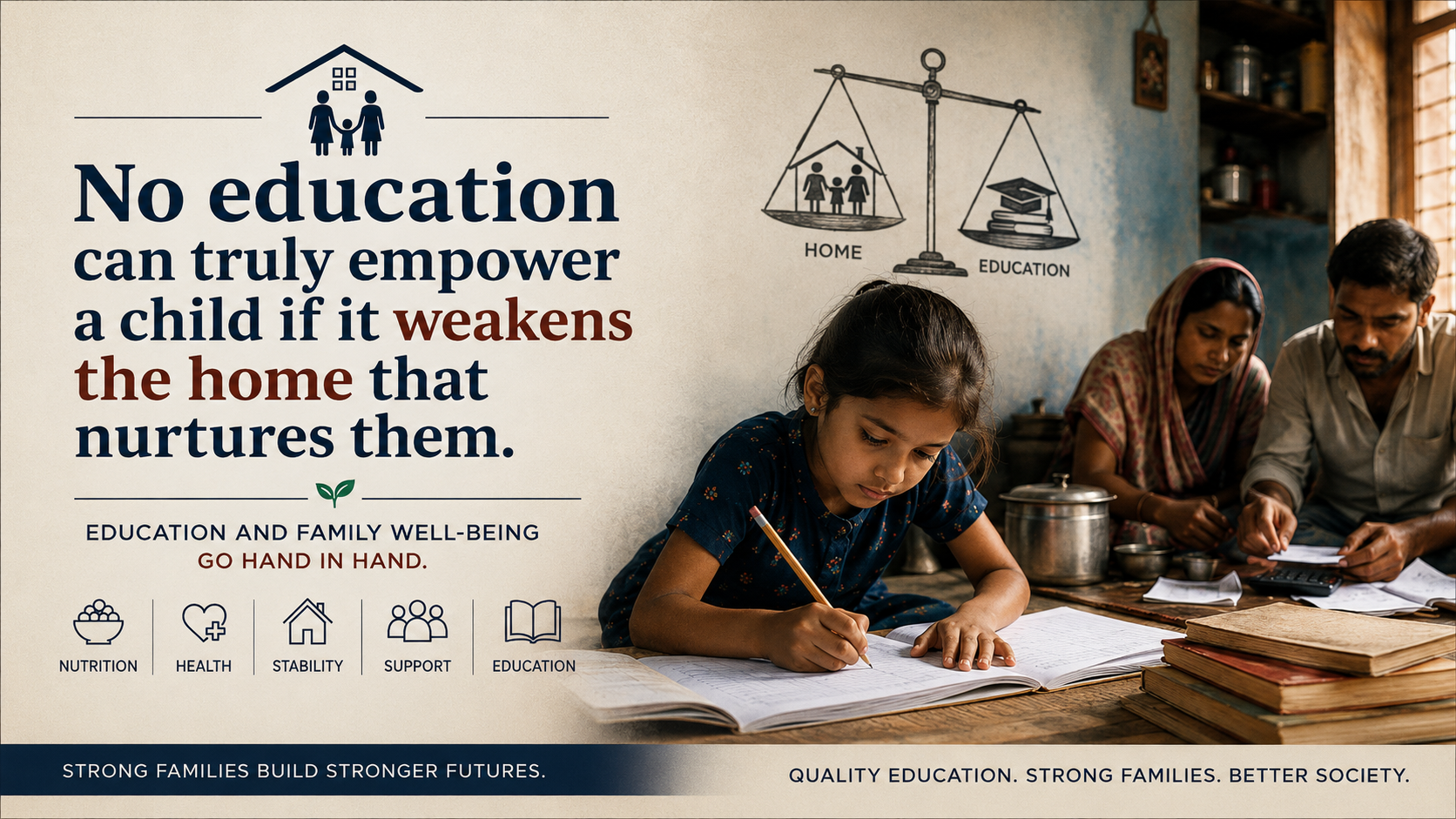
Quality Education Cannot Be a Privilege
Education is not a luxury. It is not a premium commodity reserved for those who can afford high fees, branded campuses, and expensive resources. Education is a fundamental right of every child. Yet for millions of poor and disadvantaged families, quality education remains financially out of reach—not because they do not value it, but because the current structure of schooling often makes quality unaffordable.
This is one of the greatest contradictions of modern education systems.
Families with average and high incomes can choose between premium schools, average private schools, or specialized educational options. They can compare facilities, pedagogies, and opportunities. They have the power of choice. But poor families are often left with no such freedom. Their options are usually limited to under-resourced institutions or unaffordable private alternatives. In effect, quality becomes a matter of economic privilege rather than educational right.
This must be challenged.
Poverty Should Not Decide Educational Quality
Research in educational equity consistently shows that children from disadvantaged backgrounds need quality education the most. Poverty is already associated with nutritional deficits, unstable housing, health vulnerabilities, and reduced learning opportunities at home. In such conditions, school becomes not just a place of instruction but a vital institution of social correction and opportunity.
Yet this same population faces the greatest barriers to quality schooling.
Recent household income data from India’s Periodic Labour Force Survey (PLFS) and the CMIE Consumer Pyramids Household Survey reveal a sobering reality: the poorest 10% of households survive on an average monthly income ranging between ₹3,139 and ₹4,156. If educational affordability is to remain humane and sustainable, even a 15–20% allocation to schooling would amount to only ₹500–₹800 per month for the entire household—not per child. This has profound implications for school design. It means that many so-called “affordable” schools remain structurally inaccessible to the poorest families, often forcing them into impossible trade-offs between education, nutrition, health, and basic dignity.
The hidden cost is often paid in survival.
| Sacrifice | Educational Consequence |
|---|---|
| Less nutritious food | Poor brain development, low concentration |
| Reduced healthcare | Frequent illness, absenteeism |
| No books or literacy materials at home | Lower language growth |
| Unstable housing or debt | Emotional insecurity |
| Parental stress and conflict | Reduced emotional support |
These are not secondary issues. They are central to learning itself.
Learning Is Built on More Than Schooling
Research in child development and neuroscience has repeatedly shown that nutrition and emotional stability are foundational to learning. Studies by Burrows et al. (2017) and Jyoti et al. (2005) demonstrate strong links between food security, cognitive functioning, and academic performance. Abraham Maslow (1943) argued that physiological and emotional needs must be met before higher-order learning can occur.
Similarly, Urie Bronfenbrenner (1979) emphasized that the child’s development depends on the interaction between family, school, and society. If schooling creates financial strain that weakens the family system, the child’s learning environment suffers as a whole.
A child with affordable schooling, proper nutrition, and emotional security may learn better than a child in an expensive school but under chronic household deprivation.
This is why educational affordability is not merely an economic issue—it is a pedagogical issue.
The Need for a New Educational Principle
If quality education is truly a right, then it must be designed around the realities of the poorest, not the convenience of the privileged.
No child should lose nutrition for education.
This principle does not reduce the value of schooling. Rather, it elevates it by placing education within the broader framework of child well-being.
Household economics suggests that families need to balance spending across multiple essential domains. A practical household-first model would prioritize:
- 50% for food and essentials
- 20% for housing and utilities
- 10% for health and emergencies
- 15–20% for education
- 5–10% for savings and social needs
This means the total cost of schooling for all children in a family should ideally remain within 15–20% of household income. Beyond this, education risks becoming economically extractive rather than empowering.
The Urgent Need for Alternative School Models
This is why initiatives such as the Resource-Rich, Low-Cost School Initiative are becoming increasingly important. Their significance lies not in offering “cheap” education, but in proving that quality can be made accessible without placing impossible burdens on poor families.
- Strong teaching rather than expensive buildings
- Shared digital resources rather than repetitive material costs
- Community-supported libraries rather than isolated resource ownership
- Multi-age and flexible learning structures
- Volunteer participation and social partnerships
- Low operational waste with high learning value
These approaches show that educational quality need not be tied to high fees.
Education as Justice, Not Market Choice
The central issue is not whether wealthy families can continue paying for premium schooling. They can, and they will. The real question is whether poor children will also be given the right to quality.
Not diluted quality. Not second-grade quality. Not survival-level schooling.
But genuine, meaningful, resource-rich education.
The United Nations Convention on the Rights of the Child (1989) affirms education, health, and nutrition as indivisible rights. If one right is pursued by sacrificing another, justice remains incomplete.
Therefore, the future of education must move beyond the assumption that quality belongs to those who can pay more. The moral test of any educational system lies in this:
Can the poorest child access quality education without pushing the family deeper into deprivation?
If the answer is no, reform is not optional—it is necessary.
Because quality education should never be a privilege of wealth. It must remain the right of every child.