

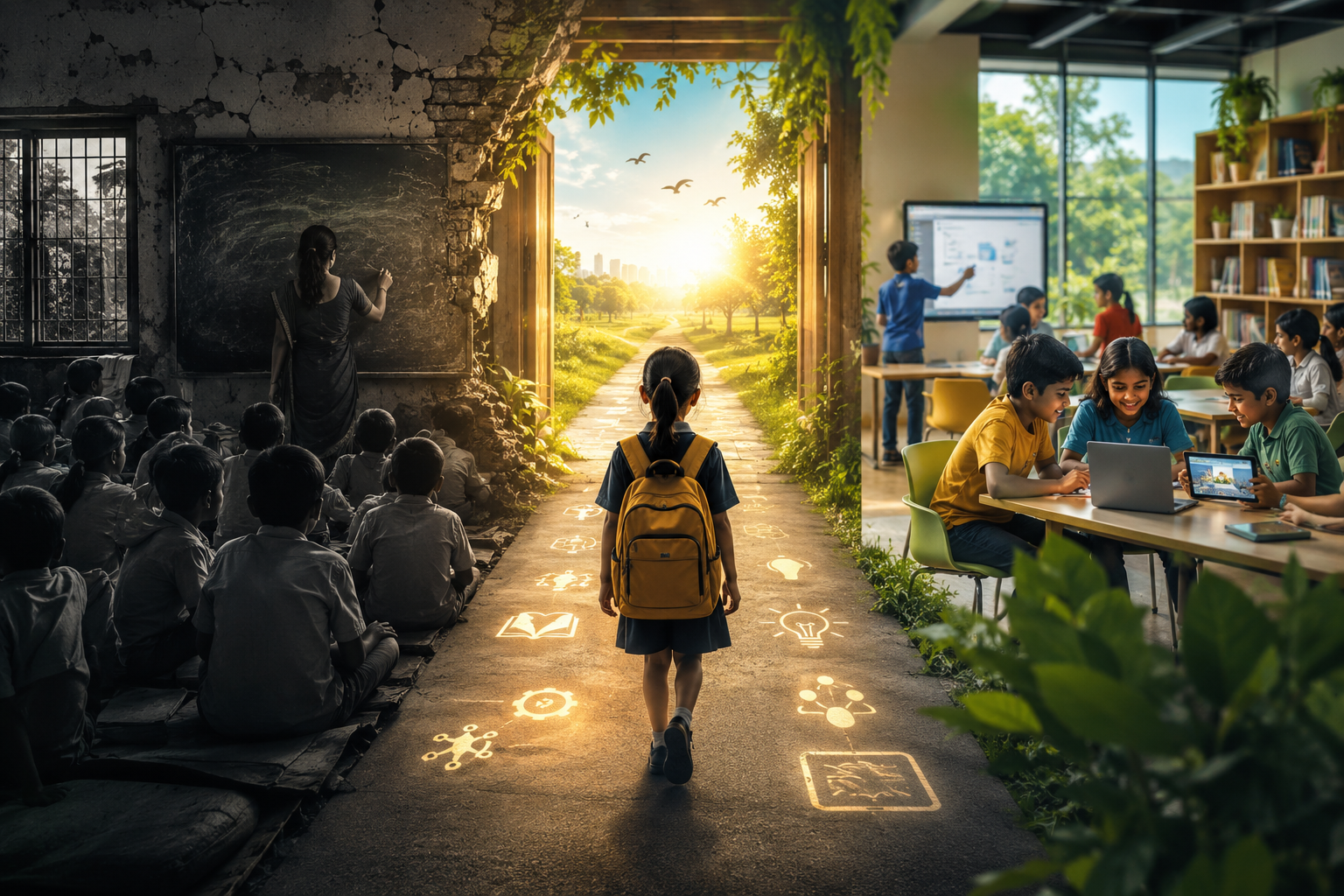
Why We Need a Different Kind of School
For generations, the public imagination of a “good school” has been deeply shaped by material appearances. Large campuses, imposing buildings, sophisticated infrastructure, branded uniforms, and expensive facilities have increasingly come to signify what is popularly understood as quality education. This perception has shaped parental aspirations, institutional practices, and educational markets alike.
Yet this assumption deserves closer scrutiny. Can the visible architecture of schooling be equated with the invisible processes of learning?
A well-designed building may provide comfort and prestige, but it cannot in itself produce critical thinking, reading habits, intellectual curiosity, or pedagogical depth. The growing association between educational quality and infrastructural grandeur reflects a broader commodification of schooling, where symbolic capital often overshadows educational substance.
The Expanding Educational Divide
Across urban and semi-urban contexts, premium private schools increasingly offer a range of enhanced facilities—swimming pools, horse riding, climate-controlled classrooms, and technologically integrated environments. These undoubtedly enrich the schooling experience for some, but they also raise the cost of access significantly.
At the other end of the spectrum are schools that remain financially accessible but often struggle with limited resources, weak libraries, insufficient teacher development, and minimal technological integration.
The result is a dual structure: one system rich in opportunity but socially exclusive, and another accessible but pedagogically deprived.
This divide raises an important policy question: should educational quality remain linked to economic capacity?
The Moral Basis of Educational Access
The question is not merely administrative or financial. It is moral. If quality education is understood as a right, then its availability cannot remain contingent upon household income. The persistence of reservation-based access to elite institutions for disadvantaged groups itself indicates a deeper structural imbalance.
The problem lies not only in unequal access to existing schools, but in the underlying design of schooling itself.
Re-centering the Core of Education
If one strips away the peripheral layers of schooling and returns to its essentials, two elements remain central: teachers and learning resources.
Educational research has repeatedly affirmed that teacher quality remains one of the strongest school-based determinants of student learning. Likewise, access to rich reading materials, adaptable content, and intellectually stimulating environments plays a crucial role in educational growth.
The quality of education lies less in architecture and more in pedagogy.
This distinction is critical because it shifts attention from capital-heavy infrastructure to human and intellectual investment.
Technology and the Possibility of Redistribution
Contemporary technological shifts have made it increasingly possible to create, personalize, and distribute educational resources at significantly reduced costs. Digital ecosystems can decentralize access to quality content, reduce dependency on expensive physical systems, and support teacher autonomy.
This presents an important opportunity for rethinking school models.
A school need not be financially extravagant to be educationally rich.
Towards a New Schooling Framework
A new schooling framework must prioritize:
- Learning over infrastructure
- Teachers over bureaucracy
- Technology over excessive paperwork
- Resources over decoration
- Reading over rote learning
- Community over competition
These are not merely operational choices. They are philosophical commitments that can reshape the future of educational justice.
Conclusion
As educational costs continue to rise and inequalities deepen, the urgency for alternative school models becomes more pressing. If quality continues to be equated with cost, education will increasingly reproduce privilege rather than reduce it.
The future of schooling must move towards models that are intellectually rich, financially sustainable, and socially inclusive. Such a shift is no longer optional; it is necessary.
The future of education will not belong to the most expensive schools. It will belong to the most thoughtful, equitable, and human-centered ones.